Key facts: Slow draining sink
- Grease poured down drains solidifies and blocks pipes; the City of Dayton asks residents to put it in the trash [1].
- Groundwater in the Great and Little Miami basins is very hard calcium-magnesium-bicarbonate water [2].
- Dayton's water plants use lime softening, which lowers hardness for city customers but not for private wells [3].
- A trap holds a water seal that blocks sewer gas; a vent lets the drain flow freely [4][5].
Short answer
Why is only one sink draining slowly?
When one sink drains slowly and the rest of the house is fine, the restriction is in that sink's own branch: the pop-up stopper, the trap, or the short pipe running into the wall. In a bathroom it is usually hair bound up with soap. In a kitchen it is usually grease and food that cooled and stuck to the pipe wall. The City of Dayton notes that grease poured down drains solidifies and causes blockages, which is why it asks residents to put it in the trash [1].
If two fixtures on the same wall are slow, look further down the branch. If basement drains, toilets and tubs are all sluggish, the problem is the main line and a sink-only approach will not help; see our guide to a toilet and tub backing up together.
What you see / likely cause / what to do
Slow sink symptoms side by side
| What you see | Likely cause | What to do |
|---|---|---|
| Bathroom basin slow, stopper slimy with hair | Hair and soap at the pop-up and trap | Pull and clean the stopper; clean the trap if needed |
| Kitchen sink slow, worse after cooking | Grease and food coating the trap arm and branch | Stop pouring fats; book kitchen drain cleaning if it persists |
| Slow sink that also gurgles loudly | Partial clog or a blocked vent pulling the trap seal | Clear the branch; have the vent checked |
| Both kitchen bowls and the dishwasher slow | Shared branch or trap restriction | Branch cleaning past the trap |
| White crust inside the trap, slow for years | Mineral scale narrowing the pipe | Mechanical cleaning or jetting of the branch |
| Sink slow and a nearby tub or toilet slow too | Restriction further down the drain line | Main line cleaning and a camera check |
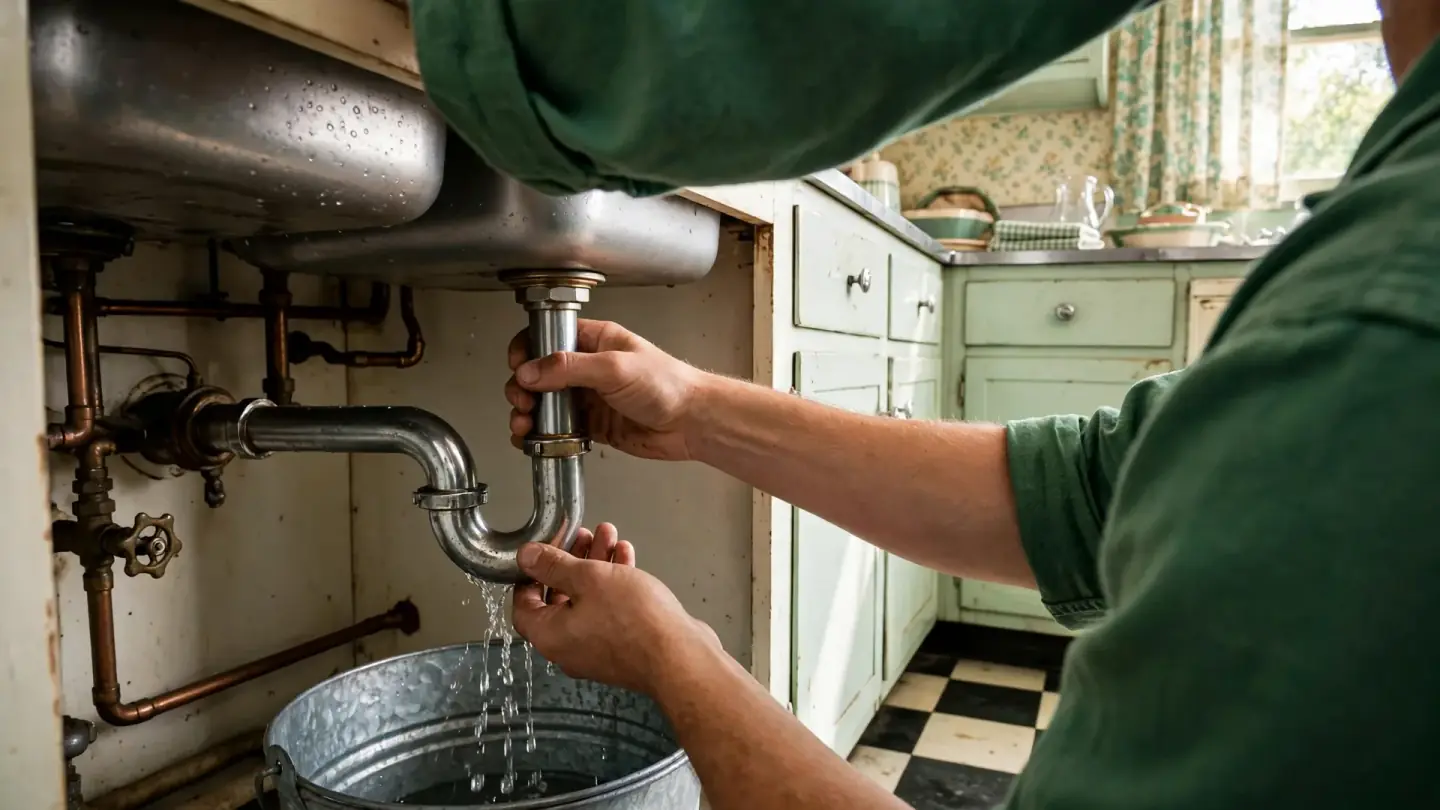
Under the kitchen cabinet
Safe checks
Under-sink checks that do no harm
- Remove the bathroom pop-up stopper and clean hair and film off it. This alone fixes many slow basins.
- Clear the overflow hole with a soft brush; a blocked overflow can slow draining in some basins.
- Run hot tap water for a minute, then watch: a steady swirl means the restriction is light; a rising bowl means it is close.
- Use a cup plunger on a kitchen sink with the other bowl plugged and the dishwasher hose clamped or the dishwasher off.
- If you remove a trap, put a bucket under it first and expect dirty water.
- Skip caustic chemicals. They seldom clear grease fully and make the next plumber's work hazardous.
Cause 1
Grease and food in the kitchen branch
Hot grease looks harmless going down the sink. It cools within a few feet, sticks to the top and sides of the pipe and catches food particles and soap. Each layer narrows the bore a little. Eventually the sink holds water for a minute after each use, and that is the point most people call. The City's grease guidance is direct: put it in the trash and do not pour it down the drain [1].
Plunging can push a grease plug deeper. A contractor doing kitchen drain cleaning usually runs a cable through the trap arm to the branch and, where the coating is heavy, uses water jetting so the wall is cleaned rather than just poked through.
Cause 2
Hair, soap and hard-water scale in bathroom basins
Bathroom basins collect hair, toothpaste, shaving residue and soap. Soap reacts with calcium and magnesium in water to form scum that binds hair into a mat at the stopper and trap. The USGS describes surface and ground water across the Great and Little Miami basins as very hard calcium-magnesium-bicarbonate water [2]. Dayton's own plants lime-soften the supply, which helps city customers [3], but homes on private wells or other unsoftened supplies see more scale in fixtures and drain pipes.
Scale is slow. It narrows a pipe over years and roughens the wall so hair snags more easily. A contractor doing bathroom drain cleaning can remove the mat and, if needed, cable or jet the branch to take scale back to the pipe wall.
Cause 3
Can a vent problem make a sink drain slowly?
A drain needs air to flow. The vent stack lets air in behind the water so it does not form a vacuum, and the trap holds a water seal against sewer gas [4][5]. If the vent is blocked by a bird nest, leaves or ice on the roof, water drains slowly and the trap gurgles as air is pulled through it. The sink looks clogged but the pipe is clear.
The clue is noise and a trap that loses water. A contractor checking a slow sink with no visible restriction will look at venting before assuming a deeper clog. Our gurgling drains guide covers vent problems in more depth.
How a contractor diagnoses it
Working out where the sink is restricted
- 1
Check which fixtures are slow
The contractor runs water at nearby fixtures to see whether the problem is one sink, one branch or the whole house.
- 2
Inspect stopper and trap
The stopper and trap are opened and checked for hair, grease or scale. A clean trap points further down the branch.
- 3
Cable the branch
A small drum machine clears the trap arm and the line in the wall, and the cable end often brings back evidence of what was there.
- 4
Camera recurring problems
For a sink that keeps slowing, a small camera in the branch shows grease build-up, scale or a sag. Ask to see the footage so you know what was cleared.
- 5
Test drainage and venting
The sink is filled and released to confirm full flow, and gurgling is checked to rule out a venting fault.
Fix options
Clearing a slow sink properly
Light hair restrictions end with a cleaned stopper and trap. Grease and scale in the branch call for a cable or a jet, because a hole punched through the middle closes again within weeks. If the camera shows a belly or a poorly pitched trap arm, re-piping that short section stops water from standing where grease settles. A blocked vent is cleared from the roof or the stack. For anything beyond one fixture, ask about clogged drain repair on the shared line.
Browse the rest of the Dayton guides for neighbouring problems: gurgling noises from drains and frozen lines in winter both start out looking like a slow sink.
Prevention
Keeping sinks draining at full speed
- Wipe greasy pans with a paper towel and put grease in the trash, as the City asks [1].
- Fit a basket strainer in the kitchen and a hair catcher in bathroom basins.
- Clean the bathroom pop-up every few weeks before hair builds up.
- Run plenty of water after using the disposal so scraps clear the trap arm.
- If you are on a private well, consider whether softening makes sense; hard water builds scale faster.
What to tell the contractor
What to mention about a slow sink
- Which sink, and whether it is kitchen or bathroom.
- How long it has been slow and whether it is getting worse.
- Whether other fixtures nearby drain slowly or gurgle.
- Whether you have used chemical openers, and which ones.
- Whether you are on city water or a private well.
FAQ
Slow sink questions
Is a slow bathroom sink usually caused by hair?
Usually, yes; hair bound up with soap scum at the stopper and trap is the most common cause. Pull and clean the stopper, then check the trap if you are comfortable. If the sink is still slow afterwards, the restriction is further into the branch line or the vent, which is where a contractor's tools help.
Will pouring boiling water clear a slow kitchen sink?
It may loosen a thin grease film for a short time, but grease cools and settles again further down the pipe. Very hot water can also damage some plastic fittings. Mechanical cleaning removes the coating from the pipe wall instead of pushing it deeper, so the sink stays clear longer.
Does Dayton's hard water cause scale buildup in drains?
Groundwater in the Miami Valley is naturally very hard [2]. The City of Dayton softens its supply with lime treatment [3], which reduces scale, but soap scum still forms and private wells are not treated. Over years, that residue narrows sink drains and traps, especially in older bathroom branches.
Why does my sink gurgle while it drains slowly?
Gurgling means air is being pulled through the trap as water struggles past. That usually points to a partial clog downstream or a vent that is blocked [5]. Both slow the flow. The contractor you are connected with can test the line and the vent to tell you which one is the cause.
When is a slow sink a sign of a main line problem?
It is a main line warning when several fixtures slow at once, or water appears in a tub or basement floor drain when the sink runs. That pattern means the shared line further down is restricted. Stop using water heavily and call to describe which fixtures are affected.
How can I keep a kitchen sink from draining slowly again?
Wipe greasy pans with paper towel before washing, scrape plates into the trash, and avoid running fibrous or starchy scraps through the disposal. Grease that cools in the pipe is what builds up over time. If the sink keeps slowing despite good habits, have the branch cleaned and filmed.
Is it safe to take apart the P-trap under my sink myself?
For many people, yes, with care. Put a bucket underneath, loosen the slip nuts by hand, and clear the trap before refitting it snugly. Skip this if chemicals were poured in recently, because they can splash. If the trap was clear, the slowdown is further into the pipe [4].