Key facts: Emergency Hydro Jetting
- Grease poured down drains solidifies and blocks sewer lines; Dayton asks residents to bin grease and restaurants to keep grease traps maintained [1].
- There is no fixed schedule for root cleaning a Dayton lateral; frequency depends on pipe condition and nearby trees and shrubs [1].
- If a Dayton lateral is broken, a licensed plumber pulls a permit and repairs the private side [1].
- Many South Park homes date from the 1880s to the early 1900s, an era of clay and cast iron sewer laterals [2].
When cabling stops working
Signs a recurring blockage has outgrown a cable
Back within weeks
A line that needed cabling again a few weeks after the last visit probably has grease, sludge or root mass left on the walls.
Grease returned on the cable
If the last clearing brought back a cable coated in grey fat, the pipe wall is lined with the same material.
Fine root hairs every time
Fine roots regrow quickly from clay joints; a cutter opens a hole but leaves a fringe that catches paper again.
Slow even when clear
A drain that never runs at full speed after clearing suggests the bore is narrowed along its length, not blocked at one point.
Jetting versus cabling
What does a jetter do that a drain cable cannot?
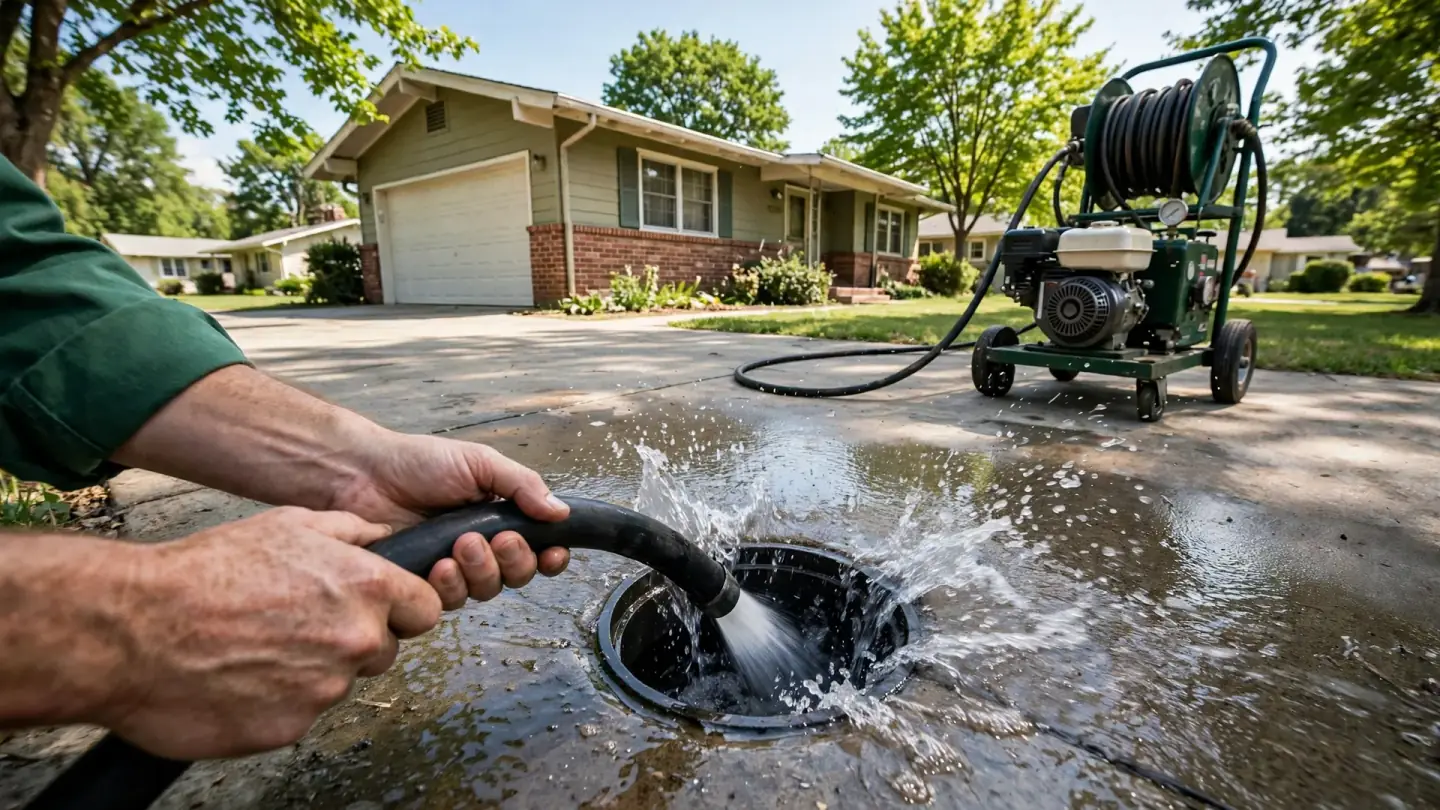
A cable machine spins a cutter through a blockage. It is quick and effective at restoring flow, but it bores a path roughly the size of the cutter and leaves whatever coats the wall in place. A jetter sends water through a nozzle at high pressure. Rear-facing jets scour the pipe wall as the hose travels and pull it forward; forward jets cut into packed material ahead. The debris is flushed down to the main.
That difference matters most for grease and fine roots. The City of Dayton explains that grease solidifies in sewers and blocks them [1]; in a kitchen or restaurant line, it builds in layers that a cable slices through without removing. Root hair growing through clay joints, common in laterals from the late nineteenth and early twentieth centuries such as those under South Park and the Oregon District [2][3], responds the same way. Jetting cleans the circumference, which is why lines that close again quickly after cabling often stay open far longer after a proper jet.
In an emergency, though, jetting is rarely the very first tool. When a line is completely blocked and full, the contractor usually opens it with a cable to get the water moving, then decides whether jetting is warranted once the pipe can be seen. The routine version of this service is described on the hydro jetting page.
Unsure whether jetting is even the right response? Start with the emergency drain cleaning triage page.
Safe or not
Pipe conditions where jetting helps or harms
| Condition seen or suspected | Jetting fit | Why |
|---|---|---|
| Grease coating in a sound kitchen or restaurant line | Usually good | Scours fat off the wall rather than punching through it |
| Fine roots at clay joints, pipe otherwise intact | Often good | Strips root hair; heavy roots may need a cutter first |
| Scale and soap sludge in cast iron | Often good, with care | Clears buildup; badly thinned iron needs gentler settings |
| Cracked or offset clay joint | Use caution | Water can wash out bedding soil; camera first |
| Collapsed, crushed or broken pipe | Not suitable | Jetting cannot open a collapse and can enlarge the break |
| Bituminous fibre or deteriorated pipe | Not suitable | Soft wall material can delaminate under pressure |
Urgent jetting visit
The order of work on an emergency jetting job
- 1
Restore basic flow
If the line is full, a cable opens it first so standing water drains and the contractor can see into the pipe.
- 2
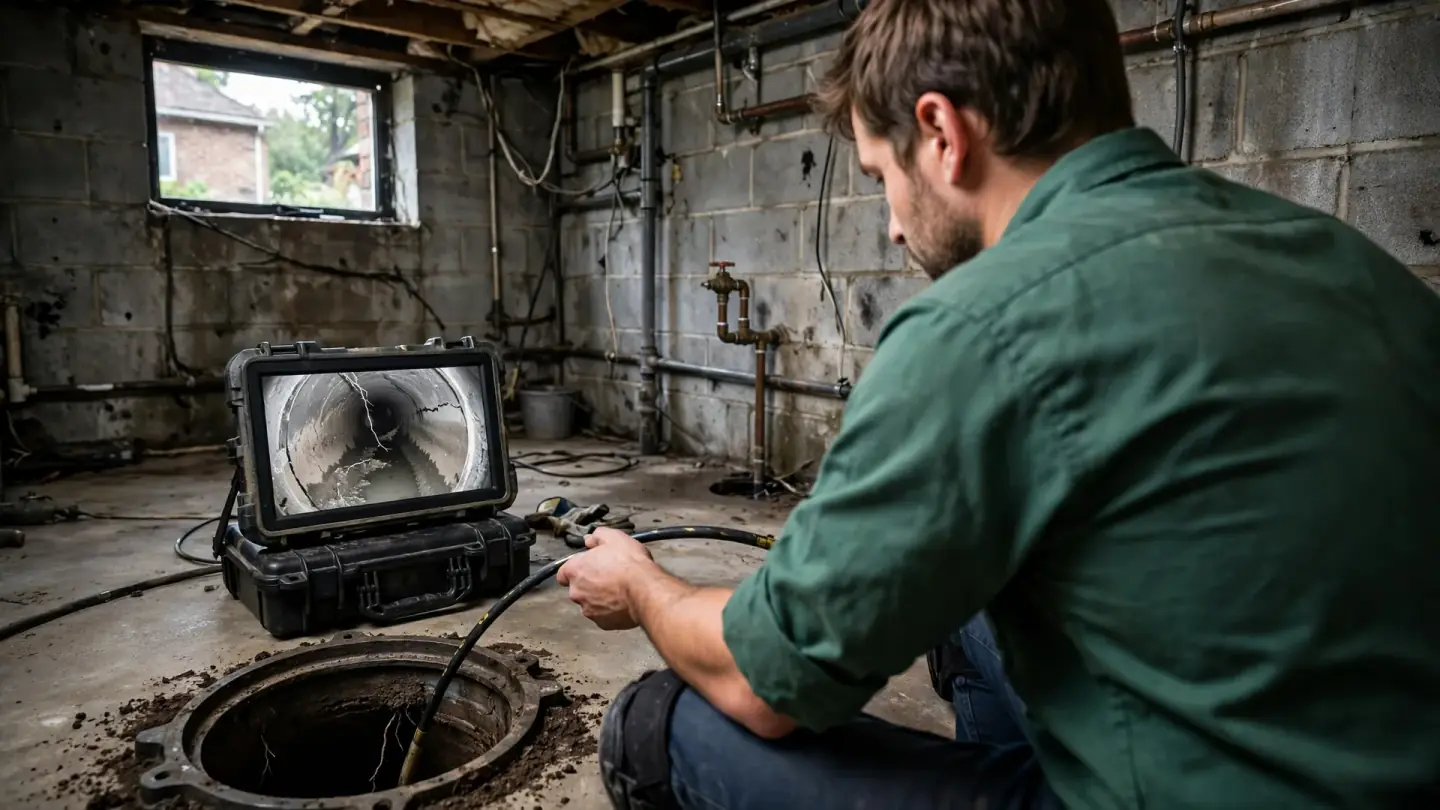
Pre-jetting camera survey of the pipe
A drain camera inspection checks for breaks, offsets, sags and pipe material before any pressure goes in.
- 3
Choose nozzle and pressure
The contractor matches the nozzle and pressure to the pipe and what is in it: grease, roots or scale.
- 4
Jet from the cleanout outward
The hose travels toward the main and is drawn back slowly, giving the rear jets two passes over the wall.
- 5
Camera again
A second look shows how much of the wall was cleaned and whether anything found earlier needs repair.
When it is not jetting
What happens if the camera finds a broken sewer lateral?
Sometimes the reason a line keeps blocking is that it is broken: a crushed section, an offset joint, a belly where waste settles. Jetting cannot fix any of that, and the camera footage becomes the basis for a repair plan instead. In Dayton, the City's FAQ explains that a broken lateral is repaired on the private side by a licensed plumber under a permit, while street-side work in the right-of-way is done by City crews and billed through the plumber [1].
If the backup instead affects several properties during heavy rain, the problem may be the City main, which is cleaned and repaired by the Division of Sewer Maintenance [1]. Jetting a private lateral will not help then. The basement drain backing up after rain guide covers how to tell the difference.
Once the emergency is past, a schedule of preventative drain maintenance based on what the camera saw is usually the way to stop the cycle of repeat calls. If sewage is already backing up, start with the main line emergency page, or see all options on the list of drain services.
FAQ
Urgent hydro jetting questions
Is it safe to hydro jet an old cast iron sewer line in an emergency?
It can be, if a camera shows the pipe is intact and the contractor adjusts pressure and nozzle for its condition. Jetting badly corroded, cracked or separated cast iron can make holes worse. That is why most contractors inspect before or right after opening the line, rather than jetting blind.
Why does my drain keep clogging a week after it was snaked?
A cable punches a hole through a blockage but often leaves grease, scale or roots on the pipe walls. The line closes again as new waste catches on what remains. Jetting scours the full width of the pipe, and a camera check shows whether something structural is causing the repeat clogs.
Can hydro jetting clear tree roots from my sewer line?
Jetting with a root-cutting nozzle can remove many fine roots, and a mechanical cutter is often used on heavier root masses. Neither one repairs the joint the roots entered through, so roots tend to return. A camera inspection afterwards shows the entry point and whether a repair should be considered.
Should I let a contractor jet my line without a camera inspection first?
It is reasonable to ask for a camera inspection first, or straight after the line is opened. Seeing the pipe tells the contractor whether jetting is safe and which nozzle to use. If the line is fully blocked, they may need to open it with a cable before the camera can pass through.
Will hydro jetting fix a sewer line that keeps backing up into my basement?
It fixes the problem if the cause is buildup, such as grease, scale or sludge. If a pipe is broken, sagging or crushed, jetting may only buy time, because waste keeps collecting at the fault. A camera inspection after jetting is the clearest way to tell which situation you have.
What do I need to do before a hydro jetting crew arrives?
Clear a path to the cleanout or the access point the contractor names, and move stored items away from the basement floor drain. Stop running water and the washer, and make sure pets are secured. Have any old inspection notes or videos ready, as they help the contractor choose pressure and nozzles.