Key facts: Kitchen Drain Cleaning
- The City of Dayton warns that grease poured down drains solidifies and blocks sewer mains, and asks residents to put grease in the trash [1].
- Dayton asks restaurants to install and maintain grease traps so fats do not reach the public sewer [1].
- Lime softening at the Ottawa and Miami plants takes much of the hardness out of Dayton tap water [2].
- USGS work on the Miami basins found the local water very hard, which feeds mineral deposits in older kitchen pipe [3].
The grease problem
Why does cooking fat narrow a kitchen drain line?
Fat leaves the pan warm and liquid. Hot dishwater carries it a few feet, then the pipe cools it, and it sets on the wall like candle wax. The next rinse adds rice starch, egg, coffee grounds and the fine paste a disposal produces. Those solids stick to the fat. Over months the layers build inward until the opening is a fraction of the original pipe.
Because it builds evenly, a kitchen clog often arrives gradually. The sink drains a little slower each week, then one evening after a big meal it stops altogether. The City of Dayton describes the same process at the scale of the public sewer: grease poured down drains solidifies and blocks mains, and the City asks residents to put grease in the trash instead [1].
The location of the clog matters. The kitchen branch usually runs horizontally from the sink wall to the stack, then down to the building drain in the basement. Grease tends to collect where the line flattens and slows, often in the horizontal run inside the wall or under the basement ceiling, not in the trap you can see under the sink.
That is why the contractor you're connected with will ask how long the sink has been slowing, whether you have a disposal and a dishwasher, and whether any other drains in the house have changed. Those details tell them whether this is a short branch problem or a coating that runs all the way to the main.
Warning signs
Signs the kitchen branch is coating up with fat
Both bowls slow together
When either side of a double sink drains sluggishly, the restriction is past the point where the two sides join, in the branch rather than one basket.
Dishwasher leaves water in the tub
Dishwashers usually discharge into the sink drain or disposal. A standing puddle after a cycle often means the shared kitchen line cannot take the pump-out.
Water rises in the other bowl
Running the disposal and watching water appear in the opposite basin is a classic sign of a partial grease blockage just downstream of the tee.
Rancid smell from the sink
Decomposing fat and food inside the pipe gives off a sour odour that hot water and soap at the surface do not remove.
Gurgle after draining a full sink
A sink full of water draining past a narrowed section pulls air through the trap and makes a glugging sound.
Basement floor drain wet after dishes
If the kitchen branch joins the building drain upstream of a blockage, kitchen water can surface at the lowest drain in the basement.
The clearing
Opening and scouring a greasy sink branch
- 1
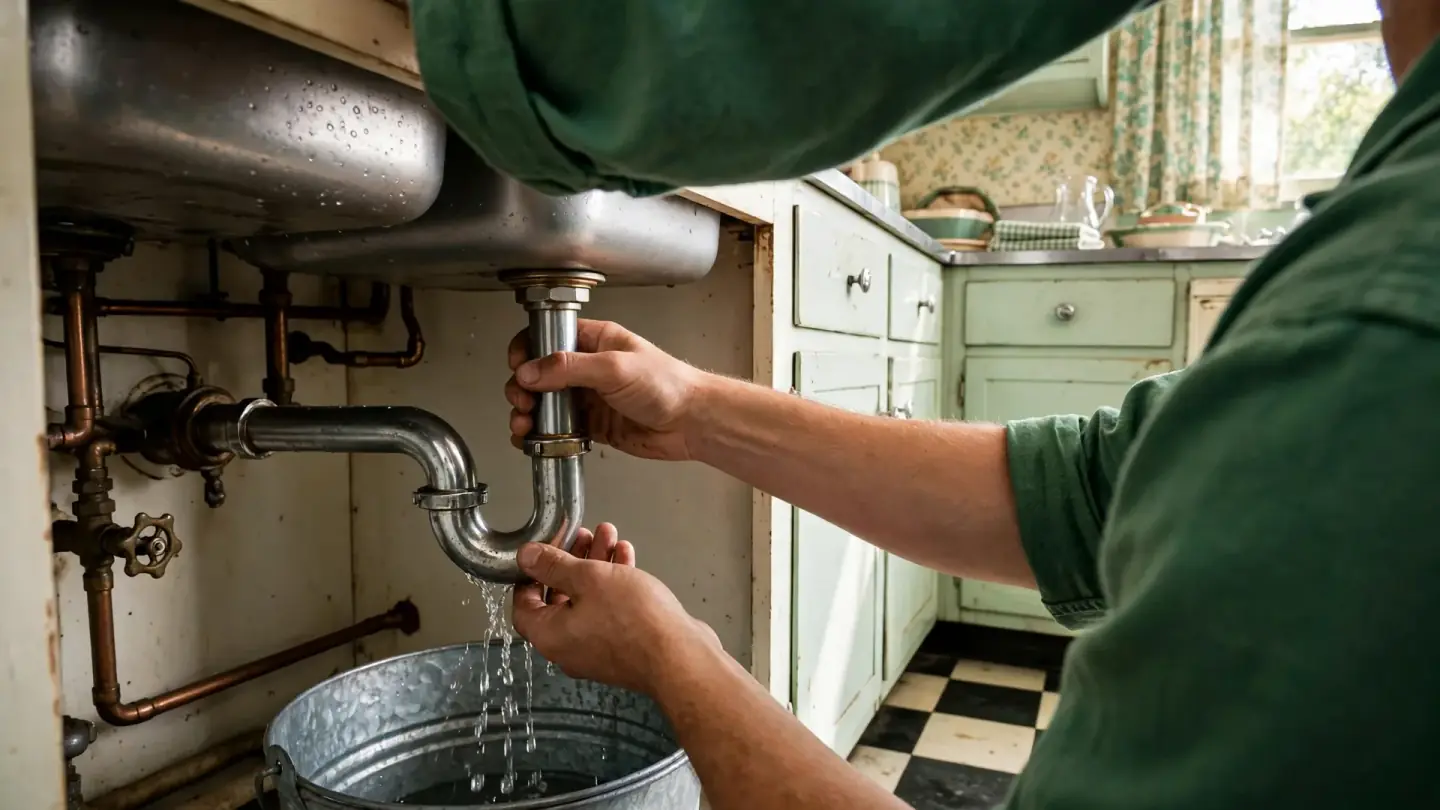
Pull the trap and check the arm
The contractor removes the sink trap to see the first few inches of pipe. Heavy grease on the trap is a strong sign the branch beyond is coated too.
- 2
Run a small cable into the wall
A drum machine sized for kitchen branches is fed through the trap arm. A cutting or spring head opens a path through the hardened fat.
- 3
Find the basement access
Where the branch drops to the basement, a cleanout on the stack or building drain may give a better angle on the longest horizontal run.
- 4
Scour the wall where it is needed
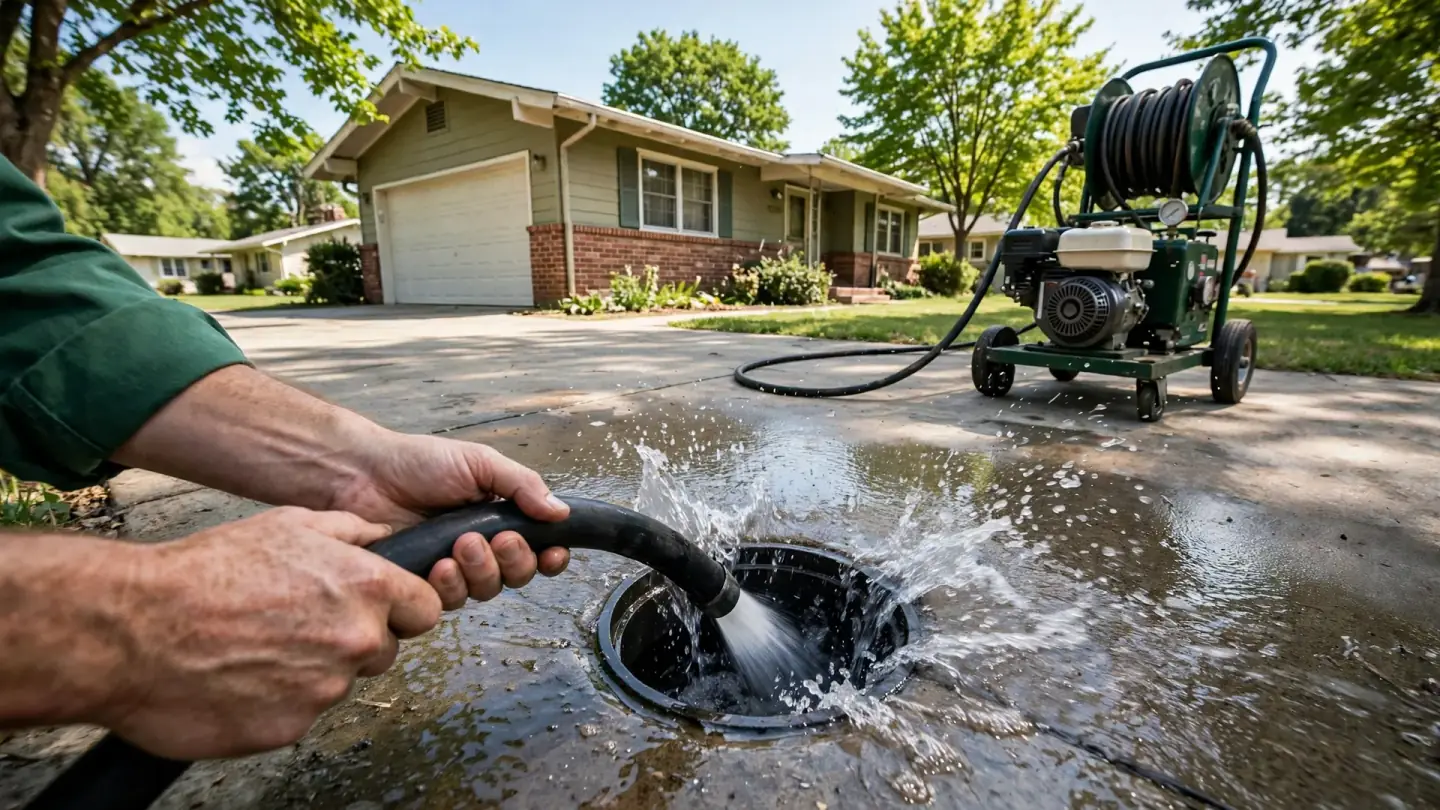
If the cable showed a thick coat, water jetting from a cleanout washes it off the full circumference so the line returns close to its original bore.
- 5
Reassemble and load-test
The trap goes back on, then both bowls are filled and released together, and the dishwasher is run, so the line is tested under a real kitchen load.
- 6
Show what came out
Grease chunks and food paste retrieved from the line, or camera footage of the cleaned branch, tell you how bad it was and how fast it built.
Kitchen clog types
Kitchen sink blockages and the right method for each
| What builds up | Where it collects | Clearing approach | Comes back if |
|---|---|---|---|
| Hardened cooking fat | Horizontal kitchen branch and building drain | Cable to open, then jetting to scour | Fat keeps going down the sink [1] |
| Disposal paste and fines | Trap and first few feet of branch | Trap cleaning and small cable | Starchy or fibrous waste is ground often |
| Rice, pasta and potato starch | Low spots where water slows | Cable and hot flushing | Starch is rinsed rather than binned |
| Coffee grounds and eggshell | Any low spot or sag | Cable, then jetting for sediment | Grounds keep going into the sink |
| Soap and mineral scale mix | Older galvanized or cast iron branch | Descaling head or jetting | Pipe is old and rough inside [3] |
| Dishwasher debris | Air gap, hose and disposal inlet | Hose and inlet cleaning | Filter is not cleaned regularly |
At the sink
Kitchen sink checks to try before you call
- Try: empty and clean both basket strainersFood packed into a strainer basket can stop a single bowl on its own. Cleaning it is the first and easiest check.
- Try: reset a jammed disposalWith power off, a hex key in the bottom of many units frees a stuck flywheel. A disposal that hums but will not turn often holds water above it.
- Try: plunge one bowl with the other sealedOn a double sink, plug the second drain tightly or the plunger only moves water from one basin to the other.
- Avoid: pouring boiling water into PVC trapsPlastic traps and joints can soften. Hot tap water helps grease flow; a full kettle into a stopped sink does not clear it.
- Avoid: caustic opener with a disposalChemicals sitting in a disposal and trap make any later work hazardous and rarely reach the coated branch inside the wall.
- Stop: when water appears elsewhereIf kitchen water rises in another fixture or the basement floor drain, the clog is downstream of the kitchen branch. Stop using water and get the line opened.
Dayton kitchens
Why do Dayton kitchen sinks grease up faster in winter?
Grease sets faster in cold pipe. On a typical January night in Dayton the airport reads around 21.8°F [4], and in many older houses the kitchen sits on an exterior wall, with its branch running through a cold wall cavity or along the basement rim joist. Cold pipe cools greasy water sooner, so fat sets closer to the sink. Holiday cooking adds roasting fat at exactly the coldest time of year, which is when calls for blocked kitchen lines spike.
Exposed lines also freeze. A kitchen branch run along an unheated wall can ice up during a hard cold snap, and the symptoms look like a grease clog. If the sink stopped on the coldest night of the week, read frozen drain lines in winter before a cable goes in, because the answer may be heat, not cutting.
Water quality is part of the picture. Dayton tap water is well water, pumped from sand and gravel under the river valley and softened with lime [2]. Softening cuts mineral scale but does nothing about fat. Homes on private wells, or suburbs with different supplies, often have harder water; regional groundwater is very hard [3], and scale in an older galvanized branch gives grease a rough surface to anchor on.
Older Dayton housing also tends to have long kitchen runs. A sink at the back of the house may travel a long way horizontally before it meets the stack. The longer the flat run, the more room for grease to settle, which is why scouring the whole branch matters more here than in a compact modern kitchen.
Past the kitchen
When kitchen grease has reached the building drain or lateral
Sometimes the kitchen is only the first fixture to complain. Grease that has travelled past the branch collects in the building drain under the basement floor and in the lateral beyond. When that happens, the kitchen and then the laundry and basement floor drain all slow down, and clearing the sink alone does not help. Clearing it means main sewer line cleaning from a basement cleanout.
A contractor can clear and jet everything on the homeowner's side, which in Dayton runs out to the street sewer [1]. Grease lodged in the public pipe itself is a matter for City Sewer Maintenance.
If the kitchen branch keeps closing up even after a thorough jetting, the pipe may have a sag or a damaged section that holds greasy water. A drain camera inspection shows where. For heavy coatings on sound pipe, hydro jetting is usually the method that returns a kitchen line to full flow.
Small food businesses have a separate obligation: Dayton asks restaurants to install and maintain grease traps [1]. Our commercial drain cleaning page covers grease interceptors and busy kitchen lines.
For other fixtures, browse the full list of Dayton drain services, or compare toilet drain clearing and preventative drain maintenance. If the kitchen is only one of several slow fixtures, the general clogged drain repair page covers whole-house blockages.
FAQ
Kitchen drain questions from Dayton households
Can I pour bacon grease down my kitchen sink if I run hot water after it?
No, hot water only moves the grease a little further before it cools and sets on the pipe wall. The City of Dayton asks residents to scrape fats and oils into the trash because they harden and block sewer mains [1]. Let pan grease cool in a can or jar, wipe greasy pans with a paper towel, and only then wash them.
Why are both sides of my double kitchen sink backing up at once?
When both bowls are slow, the blockage sits past the tee where the two bowls join. That usually means grease has built up in the horizontal run inside the wall or along the basement ceiling. Plunging one bowl while the other is open just pushes water across, so seal the second drain first or leave the branch to a contractor with a cable.
Does a garbage disposal make kitchen drain clogs worse?
It can, because a disposal grinds food into a fine paste that sticks to grease already lining the pipe. Rice, pasta, potato peels, coffee grounds and fibrous scraps such as celery are the worst offenders. Running plenty of cold water while it grinds helps, but scraping those scraps into the trash or compost is the more reliable habit.
Is a drain cable enough for a greasy kitchen sink, or do I need hydro jetting?
A cable is often enough to reopen the sink, but it only bores a hole through the grease. If the contractor finds a thick coat along the branch, jetting scours the full pipe wall so the line does not close up again within weeks. The choice depends on what the cable brings back and, where needed, a short camera look.
Why does my dishwasher leave dirty water behind after the kitchen sink slows down?
Most dishwashers pump out through the kitchen sink branch or the disposal inlet, so a restricted sink line leaves nowhere for that water to go. The pump runs but the water settles back into the tub. Clearing the kitchen branch usually solves it; if the sink drains well and the dishwasher still holds water, check the dishwasher filter and drain hose.
Does Dayton's softened water stop grease from clogging my kitchen drain?
No. Dayton lime softens its city water [2], which cuts mineral scale, but it does nothing to fat and food solids. Those still cling to the inside of the pipe whatever the water hardness. Keeping grease and starchy scraps out of the sink is what actually prevents kitchen line clogs, along with an occasional cleaning where a line has a history.
My kitchen sink stopped draining on a freezing Dayton night. Is that grease or ice?
It could be either, so start with warmth. A kitchen branch running along a cold exterior wall can freeze in a hard cold snap, and cold also stiffens grease already in the pipe. Warm the room and the cabinet gently with the doors open. If the sink drains once warm, ice was the issue; if not, grease is likely.