
Key facts: Sewer Line Inspection
- In Dayton the private lateral between the house and the public sewer is the owner's to maintain [1].
- The City will not locate a private house lateral; Plumbing Inspection may hold a location record, or a plumber can trace it with a probe [1].
- Ohio's plumbing rule deletes the IPC building-sewer sections, leaving the outside sewer to local sewer authorities and Ohio EPA [2].
- Call OUPS, now Ohio811, two working days before digging; green paint marks sewer lines [1].
How it works
What does a sewer camera see between your foundation and the street?
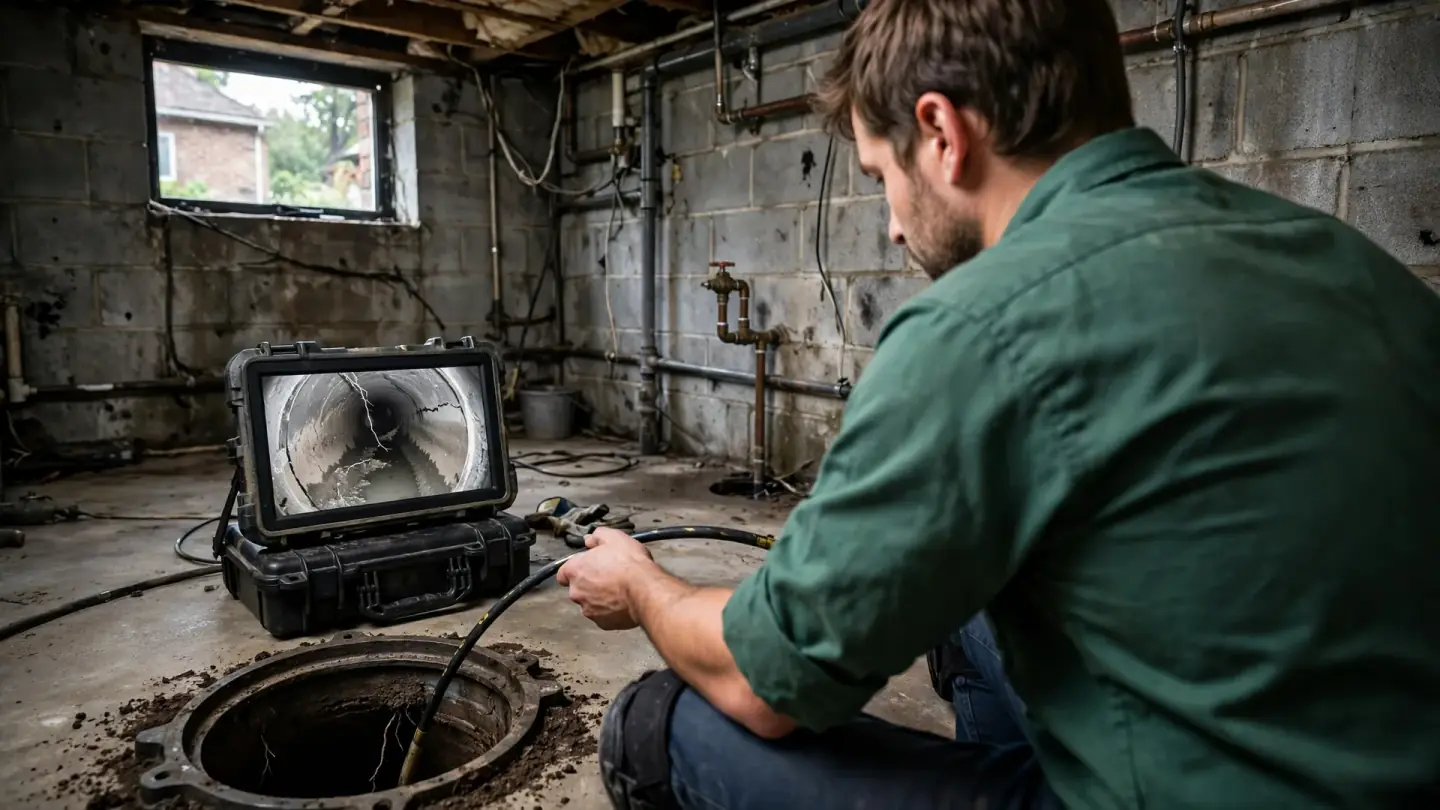
A sewer line inspection starts at an access point: an outdoor cleanout, a basement cleanout on the main stack, or, if neither exists, a pulled toilet. A self-levelling colour camera on a stiff push cable goes in and is fed slowly downstream. A counter on the reel shows distance in feet, and a small transmitter in the camera head sends a signal that a handheld locator can pick up through soil, so the pipe can be traced and marked on the surface while the camera is in it.
The run covers everything you own. In Dayton that is the whole connection between the building and the public sewer, because the City's sewer FAQ puts responsibility for the house sewer on the property owner [1]. The camera usually travels through the cast-iron section under the basement floor, through the transition at the foundation wall, along the clay, cast iron or plastic under the yard, and on to the connection at the main. Where the camera stops, either the pipe is blocked or it has reached the public line.
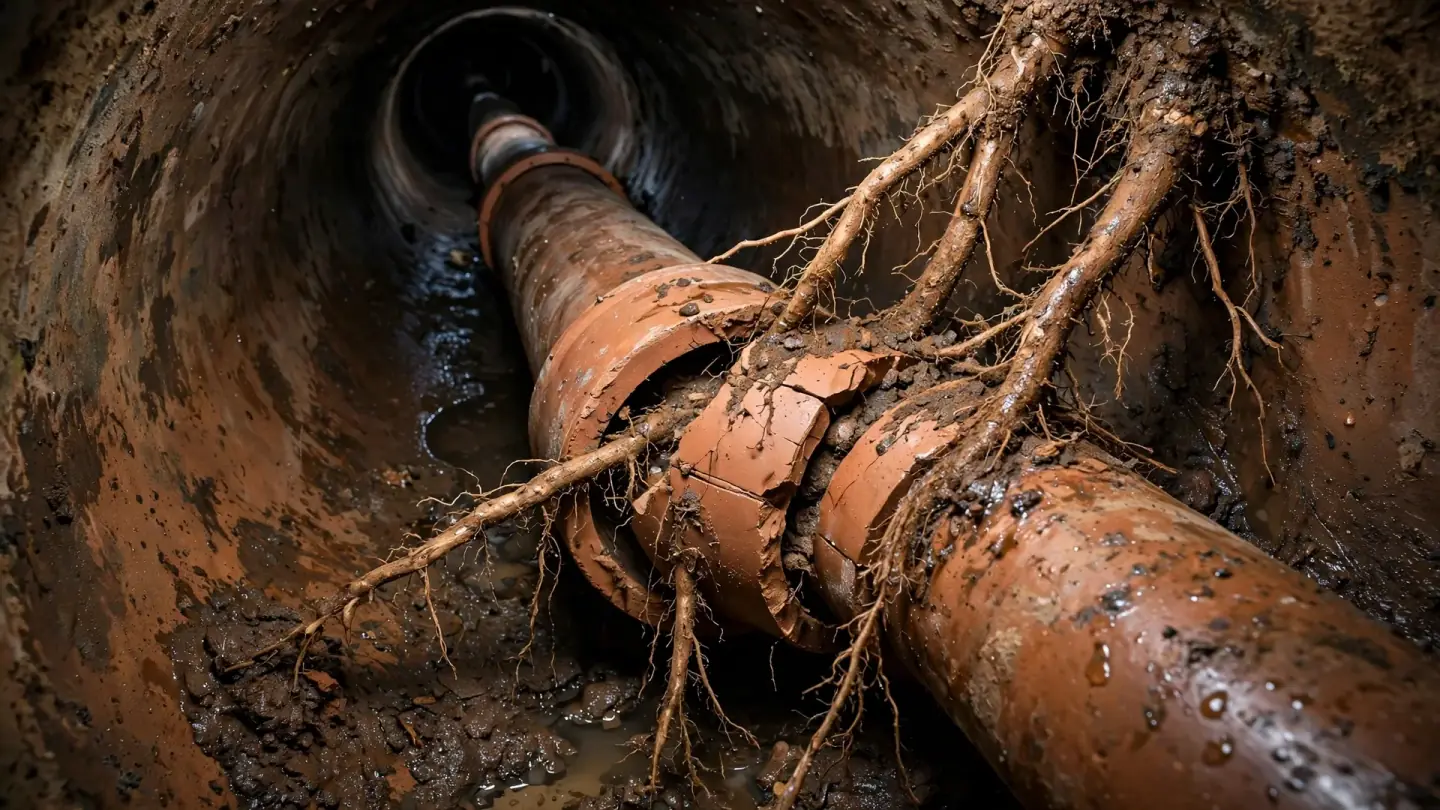
What gets recorded is the condition of each joint and each length of pipe: roots at joints, cracks, broken bell ends, belly sections that hold water, offsets where one length has dropped away from the next, and the connection itself. The footage is yours. A good report gives distances, depths at key points and a short description of each defect so a second contractor can read it without starting over.
This is a different job from finding a clog inside the house. If a kitchen sink or a second-floor tub is slow and the rest of the house drains fine, that is an interior branch problem and the right visit is a drain camera inspection of the branch line. A sewer line inspection answers bigger questions: is the lateral sound, where does it run, and is it the reason every fixture in the basement is backing up.
Signs
Clues that point to the lateral instead of one fixture
The lowest drain in the house backs up first
Water rising out of the basement floor drain or a basement toilet when an upstairs fixture runs means the shared line downstream is restricted. One sink at a time is a branch problem; the lowest opening overflowing is a lateral problem.
Roots come back on the cable every year
If a cleaning contractor pulls root fibres off the cutter each spring, something is open at a joint. A camera shows how many joints, how far out, and whether the pipe around them is still round.
A wet, sunken strip across the lawn
A soft line or a dip running from the house toward the street can mark a broken lateral leaking into the soil. The locator can confirm whether the pipe really runs under that strip.
You are buying a house built before about 1960
Older Dayton neighbourhoods commonly have clay laterals with many short joints. A pre-purchase run is the only way to see the pipe you are about to become responsible for.
Sewer smell outdoors near the cleanout
Indoors, a smell is usually a dry trap. Outside, around the cleanout or along the yard, it can mean a cracked pipe or a missing cleanout cap letting gas escape.
A previous repair with no records
If someone dug a section before you owned the house, the camera shows where the new pipe meets the old and whether those couplings are holding alignment.
The inspection
How a full-lateral inspection visit runs, start to finish
- 1
Pick the access and run water
The contractor finds the best entry, ideally a cleanout close to the foundation, then flushes a fixture so the camera has flowing water to show grade and standing water in low spots.
- 2
Clear only if the camera cannot pass
If a blockage stops the camera, a cable or jetter opens a path first. The aim is to see the pipe, so only enough cleaning is done to get the camera through.
- 3
Record the run with distances
The camera is pushed slowly to the main while recording. Each joint, crack, root mass, belly and offset is noted against the footage counter.
- 4
Locate and mark from the surface
At key defects and at the main connection, the locator picks up the camera's transmitter. The spot and approximate depth are marked so you can see the pipe route on your own lot.
- 5
Talk through the footage with you
You get the recording and a plain explanation: what is minor, what is a maintenance issue, and what needs repair. The contractor should point out the defect on screen, not just describe it.
- 6
Set out the next steps in order
That might be nothing, a root cleaning schedule, a spot repair, or a full replacement. Any work on a broken lateral starts with a permit pulled by a licensed plumber [1].
What the footage can show
Lateral defects a sewer camera reveals and what each one usually means
| Finding on camera | What it looks like | Usual response |
|---|---|---|
| Fine root hair at joints | Thin strands at each clay joint, pipe still round | Cleaning, then a root maintenance plan |
| Heavy root mass | Roots filling most of the bore at one or more joints | Cutting or jetting, then a repair plan for that joint |
| Belly or sag | Water standing in a section with no flow, debris settling | Monitor if short; repair if it holds waste |
| Offset joint | One pipe end dropped or shifted against the next | Spot repair if it catches paper or roots |
| Crack or broken bell | Visible fracture, missing piece at a joint | Spot repair or lining, depending on length |
| Collapse | Soil or rock in the pipe, camera cannot pass | Excavation and replacement of that section |
| Grease or scale lining | Pipe wall coated, bore narrowed but intact | Jetting rather than repair |
What you can do yourself
Homeowner prep before the lateral is scoped, and where to stop
- Find the cleanout. Look for a capped pipe near the foundation outside or a capped fitting on the main stack in the basement. Note where it is so the visit starts faster.
- Check Plumbing Inspection for a record. The City sewer FAQ says Plumbing Inspection may have a lateral location record for your address [1]. It is worth asking before anyone probes.
- Hold off on chemical openers. Caustic products sitting in a lateral make the job unpleasant and can hide what the camera needs to see.
- Write down history: when backups happened, after which rain, and which fixtures were involved. Patterns help separate a lateral problem from a city main problem.
- Stop at the cap. Do not open a cleanout that is under pressure from a backup; waste will come out of it. Leave that to the contractor.
- Do not dig to look. Any excavation needs an OUPS (Ohio811) call two working days ahead [1], and a lateral repair needs a permit by a licensed plumber.
Dayton specifics
Who owns which section of sewer under a Dayton street and yard?
Dayton draws a clear line. The property owner is responsible for the house lateral all the way to the sewer main; the main itself is cleaned and repaired by the City's Division of Sewer Maintenance [1]. When a lateral repair falls in the right-of-way under the street, City crews do that part and bill the plumber, who bills the owner [1]. That arrangement is exactly why the footage matters: it shows which side of the property line a break sits on.
The City will not locate your house lateral for you [1]. Its FAQ points owners to Plumbing Inspection for any location record, or to a licensed plumber with a probe, which is what the camera transmitter and locator do. Before anyone digs, Ohio811 (the former Ohio Utilities Protection Service) must be called two working days ahead; on the ground, green paint is the colour for sewer lines [1].
State code leaves the outside pipe to local rules. Ohio adopts the plumbing code's sanitary drainage chapter but deletes the building-sewer sections, so the sewer beyond the building is governed by local sewer authorities and Ohio EPA rather than the state plumbing rule [2]. In practice, for a City of Dayton address, that means the City's own permits and Sewer Maintenance.
Dayton's sanitary and storm systems are separate; laterals are not supposed to connect to catch basins, and illegal connections are disconnected [1]. A camera run sometimes finds an old downspout or area drain tied into the sanitary lateral. That is worth knowing, because rainwater in the lateral is one of the reasons a basement drain backs up after rain.
Weather is part of the story too. Dayton's January mean low is around 21.8°F with snow most winters [3], and repeated freezing and thawing moves shallow soil. Older clay laterals laid in short lengths have many joints that can open as the ground shifts, which is where tree roots find their way in.
When cleaning isn't enough
Reading the footage to decide between cleaning and repair
Most laterals that back up do not need digging. Roots at joints, grease and scale can be cut or washed out, and the camera confirms the pipe underneath is round and continuous. If that is what the footage shows, a main sewer line cleaning plus a sensible maintenance interval is the honest answer.
Repair becomes the answer when the pipe itself has failed: a collapse the camera cannot pass, a broken section that keeps letting soil in, or a belly long enough to hold waste after every flush. Cleaning a broken pipe only buys time, and jetting a collapsed section can wash more soil into it. The footage tells you which case you are in.
If you are buying, the inspection gives you something concrete to take back to the seller: the distance to the defect, the depth, whether it sits under your yard or the street, and the recording itself. That is a far stronger position than a general note that the sewer is old.
The Dayton services page lists everything else, including preventative drain maintenance when footage shows a line that needs regular cutting, and toilet drain clearing when the trouble turns out to be inside the house.
FAQ
Sewer line inspection questions from Dayton homeowners
How is a sewer line inspection different from a drain camera inspection?
A sewer line inspection follows the outside lateral from the foundation to the city main to judge its condition and route. A drain camera inspection looks at interior branch lines to find a specific clog in a sink, tub or stack. Many visits combine both, but the questions they answer differ, so say which problem you are trying to solve.
Should I get a sewer line inspection before buying an older house in Dayton?
On an older house, yes. In Dayton upkeep of the house's own sewer connection, out to where it joins the street sewer, falls to the owner [1], so a buyer takes on whatever is down there. Footage before closing shows roots, breaks or sags while you can still ask questions of the seller. Ask that the camera travel the full length to the main.
Will the City of Dayton find my sewer line before an inspection?
No. The City's sewer FAQ says it does not locate private laterals [1]. Plumbing Inspection may have a location record for your address, or the contractor can trace the pipe with a transmitter on the camera head and mark the route on the surface as the inspection goes along.
Can a sewer line inspection show whether a break is under my yard or under the street?
Yes, roughly. The footage counter gives distance from the access point and the locator marks that spot on the ground. Comparing the mark with your property line shows which side the defect is on, which matters because work in the right-of-way is handled differently from work in your yard.
What happens if the sewer inspection camera cannot get past a blockage?
The contractor first opens a path with a cable or jetter, then continues the camera run. If the camera still cannot pass, that often points to a collapse or a severe offset joint. The stopping distance is recorded and marked on the ground so any repair can be planned around the exact spot.
Do I get to keep the video from my sewer line inspection?
You should, so ask for it before the visit starts. Request the recording plus a written list of findings with distances. That lets you get a second opinion or pass the file to a repair contractor without paying for the same camera run twice, and it gives you a baseline for later checks.
Does a sewer line inspection in Dayton need a permit?
Looking at the pipe does not usually need a permit. Repair is different: the City says a broken lateral is repaired by a licensed plumber who pulls a permit [1], and any digging needs an Ohio811 call at least two working days ahead so buried utilities can be marked.
How often should an older clay sewer line be inspected in Dayton?
There is no fixed rule. The City notes that root cleaning needs depend on pipe condition and nearby trees [1]. A sensible pattern is a camera run after any backup, before buying a house, and before major landscaping or tree planting over the lateral's route, then repeat checks based on what the first recording shows.