
Key facts: Drain Camera Inspection
- A sewer smell in a Dayton basement is usually a dry trap; pouring water into trapped fixtures restores the seal [1].
- Grease poured down drains solidifies and causes blockages; the City asks residents to put it in the trash [1].
- Groundwater across the Great and Little Miami basins is very hard calcium-magnesium-bicarbonate water [2].
- Ohio's sanitary drainage rule adopts IPC Chapter 7 with modifications for drainage inside buildings [3].
How it works
How a small scope travels through traps, wyes and the stack
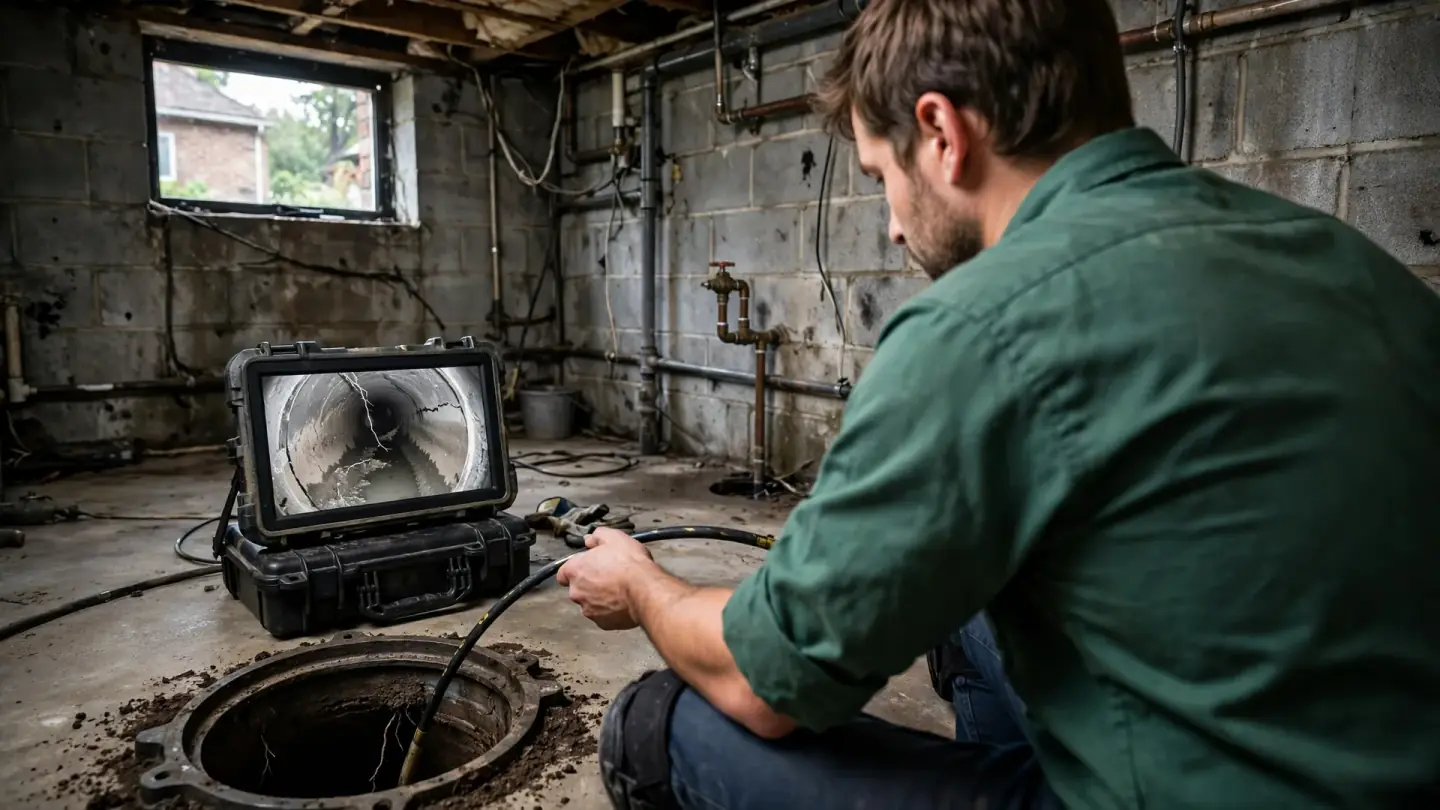
Interior drain lines are small and twisty. A bathroom sink branch may be 1.5 inches, a kitchen branch 2 inches, and the stack 3 or 4 inches, with traps, sanitary tees and wyes along the way. A drain camera for this work has a compact head, often around an inch across, on a flexible push rod that can turn tight bends. Bright LEDs light the pipe and a monitor shows the picture live while it records.
Access is usually the closest opening to the problem: a removed trap arm under a sink, a cleanout plug on the stack, a laundry standpipe, or a tub overflow. The contractor feeds the camera in and watches for the point where water stands, where debris hangs, or where the pipe changes. The footage counter shows how far in that point is, and a small transmitter in the head lets a locator find it through a wall or floor.
The point is precision. Instead of running a cable blind and hoping, the camera shows whether the problem is hair and soap two feet in, a toy lodged in a toilet bend, grease set in a horizontal run in the basement ceiling, or a fitting that was installed with too little slope. That decides the clearing tool and stops anyone opening a wall in the wrong place.
This is not a lateral survey. If several fixtures back up at once, or water comes up the basement floor drain, the trouble is likely downstream in the house sewer, and the right visit is a sewer line inspection that follows the whole lateral to the city main. The two jobs use similar gear but answer different questions.
Signs
When is an interior drain worth putting a camera in?
The same sink clogs every few weeks
Repeat clogs on one fixture mean something is catching in the branch. The camera shows whether it is a buildup, a foreign object or a bad fitting.
The tub drains slow but the sink beside it is fine
If they share a branch and only one is slow, the restriction sits before the two lines join. The camera narrows it down to that short section.
Washer water spills from the standpipe
Laundry lint and detergent build up in the standpipe and its trap. A scope shows whether it is a local plug or a problem further along the branch.
Gurgling in one fixture when another drains
Gurgling can point to a vent or a partial blockage between fixtures. Footage helps separate a clog from a venting issue; see the guide to gurgling drains.
Remodel planning around old drain pipe
Before closing a wall or floor, a camera run shows the condition of old galvanised or cast-iron branches you would otherwise cover up.
Something valuable went down
A ring or a part dropped in a drain may still be sitting in the trap or the first bend. The camera shows whether retrieval is possible.
The visit
Steps from first look to recorded proof of a clear branch
- 1
Hear the symptoms and test fixtures
The contractor asks which drains are slow and runs water at each to see what backs up where. That alone often shows which branch is involved.
- 2
Open the nearest access
A trap, cleanout or standpipe is opened so the camera reaches the problem without a long detour through other fittings.
- 3
Run the camera and mark the distance
The scope is fed in until the blockage or defect is on screen. The counter reading and a locator mark on the wall or floor fix its position.
- 4
Clear with the matching tool
Hair at a trap calls for a small auger; set grease in a long run may call for a small jetter; an object may be hooked out. The footage guides the choice.
- 5
Run the camera again
After clearing, the camera goes back in to confirm the bore is open and to check for damage that the blockage was hiding.
- 6
Hand over the recording
You receive the footage and a short explanation of what was found and what, if anything, should change: a fitting, a habit, or a maintenance interval.
Findings by fixture
What do drain cameras find in each type of household branch?
| Branch | Common finding | Usual next step |
|---|---|---|
| Bathroom sink | Hair and soap matted at the trap and first elbow | Clear by hand or small auger |
| Tub or shower | Hair mats and soap scale along the horizontal run | Auger, then a hair catcher |
| Kitchen sink | Grease set in a horizontal branch, often in a basement ceiling run | Small jetter or cutter, then habit change |
| Laundry standpipe | Lint and detergent sludge in trap and branch | Clear and fit a lint filter on the hose |
| Toilet | Object stuck in the bowl outlet or closet bend | Retrieve or pull the toilet |
| Stack or basement main | Scale on old cast iron, rough or cracked wall | Descaling or repair planning |
| Any branch | Flat or back-pitched section holding water | Re-pitch during remodel or repair |
DIY vs where to stop
Checks you can make on an indoor drain before a camera is needed
- Pull the stopper and clean it. Many bathroom sink and tub problems end here.
- Remove and rinse the P-trap under a sink with a bucket below it. If it is packed, the problem may be solved; if it is clean, the clog is further in.
- Pour water into rarely used drains. A sewer smell in a Dayton basement is usually a dry trap, and refilling it restores the seal [1].
- Test which fixtures misbehave together and write it down. That list tells the contractor which branch to scope first.
- Stop before forcing a hand auger through a toilet bend; porcelain scratches and cracks.
- Stop if more than one fixture is slow or the floor drain is involved. That points past the branch into the main, where a household tool will not reach.
Dayton specifics
Dayton basements, cast-iron stacks and hard-water buildup indoors
Many Dayton houses have the main drain lines exposed in the basement: a cast-iron stack coming down, a horizontal run along the joists, and a cleanout near the wall. That layout is helpful for camera work, because a cleanout gives direct access to the branch behind the kitchen or the bathroom group above.
Water chemistry shapes what turns up on screen. The USGS describes groundwater in the Great and Little Miami basins as very hard calcium-magnesium-bicarbonate water [2]. On a private well or an unsoftened supply, that hardness combines with soap to leave a crust in tub and sink branches. City of Dayton water is lime-softened at the plants, which slows the process but does not stop soap and grease from coating pipe.
Grease is a common culprit in kitchen branches. The City's sewer FAQ notes that grease poured down drains solidifies and blocks pipes, and asks residents to put it in the trash [1]. Inside a house, that grease usually sets where the kitchen line runs horizontally in a cool basement ceiling, which is exactly where a camera finds it.
Inside the building, drainage falls under Ohio's sanitary drainage rule, which adopts Chapter 7 of the plumbing code with Ohio modifications [3]. If footage shows a fitting with the wrong slope or a failed section that needs replacing, that is plumbing work done to code, not just cleaning.
Winter adds its own pattern. Drain lines in unheated spaces such as crawlspaces, garages or outside walls can freeze in a Dayton January, when the mean low is around 21.8°F [4]. A camera can show an ice plug in a branch, and the guide to frozen drain lines in winter covers what to do safely.
When cleaning isn't enough
Footage that turns a clog call into a fitting or pipe repair
Some findings are not clogs. A section of old galvanised branch can be so rusted inside that it never drains well again. A cast-iron stack may show a crack running along its length. A horizontal run might be pitched backward so water sits in it permanently. Cleaning helps for a while, but the cause stays.
In those cases the recording is your evidence. It shows a plumber the exact location and the defect, so the repair can be scoped as a short section rather than a wall-to-wall replacement. If you are remodelling, it tells you which pipe to replace while the wall is open.
If the camera shows a clean, sound branch but the fixture still drains poorly, the cause may be venting or a restriction further downstream. That is when it makes sense to check the main, starting with main sewer line cleaning or a lateral survey.
Camera work pairs with other jobs listed on the Dayton services hub.
FAQ
Drain camera inspection questions about indoor lines
What is the difference between a drain camera inspection and a sewer line inspection?
A drain camera inspection looks inside branch lines in the house; a sewer line inspection follows the outside lateral to the City main. The indoor version targets a specific clog or defect behind one sink, tub or laundry standpipe. The sewer version judges the condition and route of the buried line. Many homes only ever need one, depending on where the trouble is.
Can a drain inspection camera fit through a bathroom sink trap?
Small camera heads can pass some traps, but removing the trap arm is usually better. Entering the branch directly gives a clearer picture and avoids forcing the head around a tight bend, which can snag or damage the camera. The trap itself is easy to check by hand once it is off. The scope then travels the branch toward the stack.
Do I need a drain camera inspection for one clogged sink?
Usually not the first time a sink clogs. Cleaning the trap or a quick auger run often solves it. A camera becomes worth it when the same drain clogs repeatedly, when clearing it does not restore normal flow, or when several fixtures behave oddly together. Then the footage shows whether buildup, a bad fitting or damaged pipe is behind it.
Will I get a copy of the drain camera inspection footage?
Ask for it before the visit starts, and most contractors can provide it. The recording, with distance markers, lets you see what was wrong and confirm it was cleared. It is also useful for anyone doing later repair or remodel work, since it shows where the branch runs and what condition it was in on that date.
Can a drain camera find the cause of a basement sewer smell when nothing is clogged?
It can, once the simple causes are ruled out. Dayton's sewer guidance says a basement sewer smell is usually a dry trap, so pour water into floor drains and unused fixtures first [1]. If the odour stays, a camera can look for a cracked pipe, an open fitting or a loose cleanout plug letting gas into the room.
Can a drain camera locate where a branch line runs inside a wall?
Yes, a transmitter in the camera head lets a handheld locator pinpoint it through drywall or flooring. That tells the contractor where the pipe sits and roughly how deep. An access opening can then be cut exactly at the problem rather than in several guessed spots. This matters most in finished basements and older Dayton homes with undocumented changes.
Can a drain camera inspection show a frozen drain pipe?
It can show where water stops and ice starts in a branch that runs through a cold wall or crawl space. Thawing should be gentle and gradual, never with an open flame. Once flow returns, a second camera pass checks the pipe for splits caused by the freeze. Dayton winters bring enough hard cold for exposed lines to be at risk.