Key facts: Main Sewer Line Cleaning
- In Dayton the owner looks after the private sewer connection up to its junction with the public line; the City's Division of Sewer Maintenance keeps up the shared main [1].
- Repairs to a Dayton lateral in the street right-of-way are done by City crews and billed to the plumber, who bills the owner [1].
- Dayton runs separate sanitary and storm sewers; house laterals must not connect to catch basins [1].
- Ohio's plumbing rule deletes the model code's building-sewer provisions, leaving the sewer outside the building to local sewer authorities and the Ohio EPA [2].
The main line
What the building drain and Dayton lateral actually are
Inside the house, every stack and branch drops into the building drain, a larger pipe that runs under or along the basement floor to the foundation wall. Outside the wall it becomes the house sewer, or lateral, which slopes under the yard and, in most of Dayton, under the sidewalk and part of the street to the public sewer main.
The City is clear about who owns what. Everything on the private connection, up to the point where it meets the City's pipe, is the owner's job, while the City's Division of Sewer Maintenance looks after the public main itself [1]. When the lateral breaks under the street, City crews do the right-of-way repair and bill it to the plumber, who bills the owner [1]. In practice the whole private line, from the basement to the main, is yours to keep open.
Dayton's sanitary and storm sewers are separate systems. Sanitary flow goes to the treatment plant, storm water goes to rivers and streams, and laterals are not supposed to be connected to catch basins; the City disconnects illegal connections [1]. That matters when a basement floods in a storm, because rainwater should not be in your sewer line at all.
A main line clog is different from a fixture clog in scale. The pipe is usually four inches or more, the blockage may be dozens of feet away under the lawn, and the tools are larger machines with cutting heads, run from a cleanout rather than from a sink.
Whole-house warning signs
How can you tell the main sewer line is clogged and not one fixture?
Floor drain fills when the washer empties
Laundry discharge is a large, fast flow. If it comes back up through the basement floor drain, the building drain or lateral cannot take it.
Every fixture is slow at once
Kitchen, bathrooms and laundry all slowing together rules out a single branch. The common pipe they share is restricted.
Toilet flush raises water downstairs
An upstairs flush that makes water appear in a basement toilet, shower or floor drain is pushing against a main-line blockage.
Backups after heavy rain
The City lists an overtaxed or blocked main, or internal plumbing such as downspouts, foundation drains or sump pumps, as causes of rain-related basement flooding [1].
Roots or soil come back on the cable
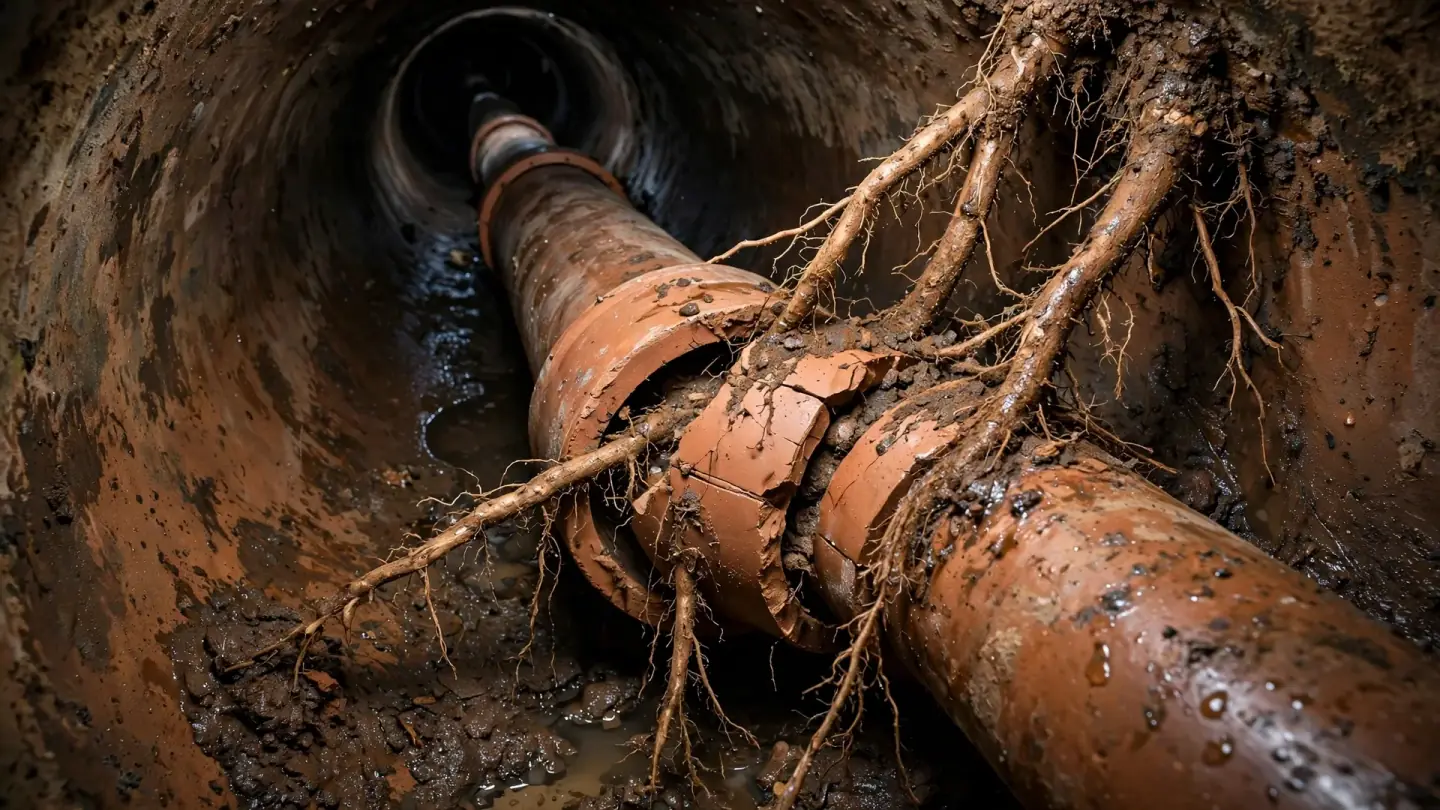
Fine roots, mud or bits of clay on a cleared cable point to a lateral with open joints or a break outside the foundation.
Main clogs on a yearly rhythm
A line that blocks around the same season each year often has roots regrowing at the same joint. The City notes there is no fixed schedule; it depends on the line and nearby trees [1].
Opening the main
Clearing a Dayton main line from the cleanout outward
- 1
Find the right cleanout
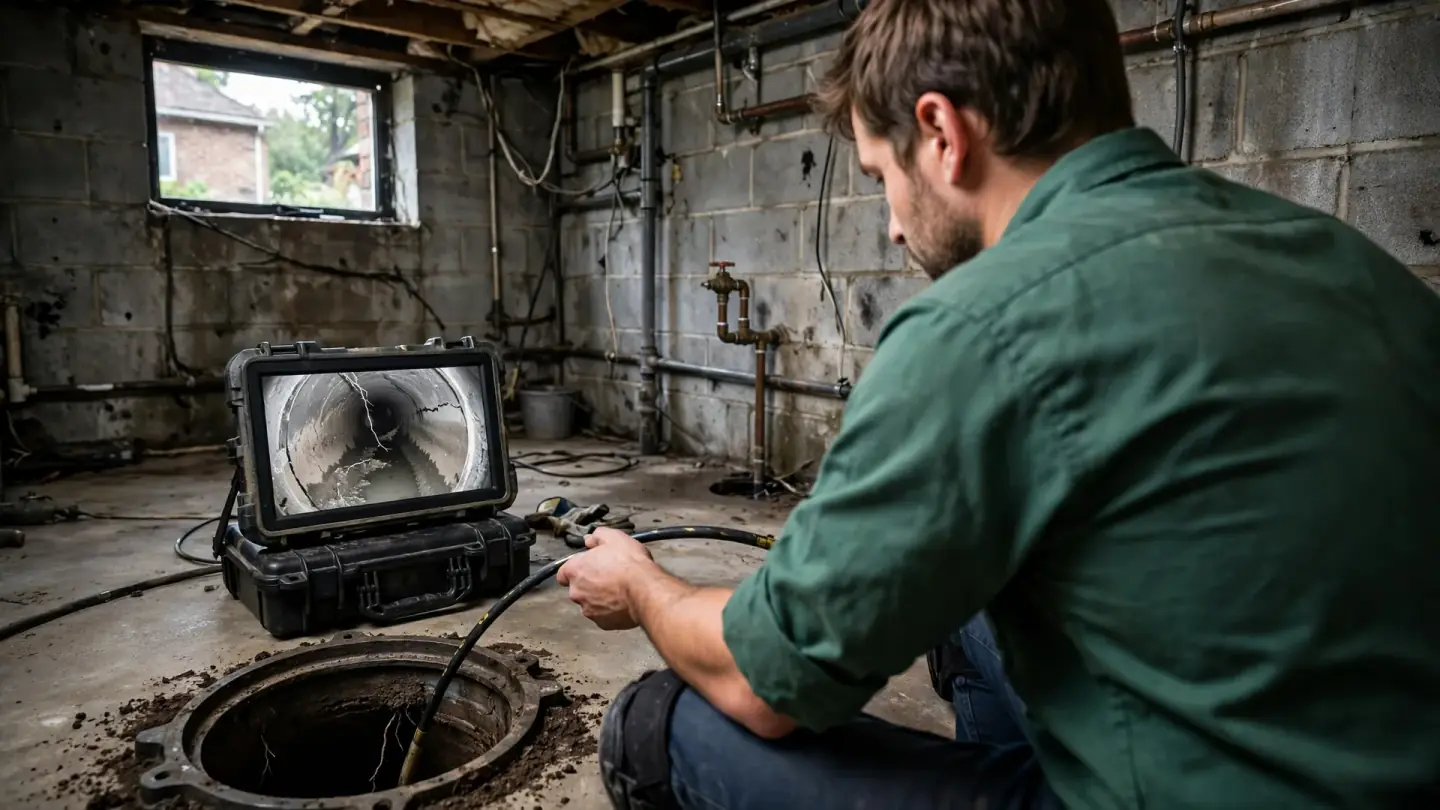
The contractor locates the main cleanout, often a capped fitting on the building drain near the front basement wall, or an outdoor riser in the yard.
- 2
Open it slowly and with a plan
If the line is full, opening the cap releases sewage. The contractor positions containment before loosening the plug so the basement stays clean.
- 3
Run a sectional or drum machine
A large machine drives cable out toward the street. Heads are chosen by the blockage: a spearhead to open, then a root-cutting blade to clear the full width.
- 4
Watch the cable and the flow
The point where the cable meets resistance, measured by length, tells roughly where the clog sits. Water falling in the cleanout confirms the line has opened.
- 5
Inspect what came back
Roots, grease, wipes or soil on the cable head say a lot about the cause. Persistent roots or soil justify a camera run before the job is called finished.
- 6
Camera and record the line
A camera pushed from the cleanout records the building drain and lateral with distance markers, so you can see the pipe condition yourself.
Main line problems
Lateral and building-drain problems and how they are handled
| Problem | Where it happens | Usual approach | Long-term answer |
|---|---|---|---|
| Root intrusion | Clay lateral joints near trees | Root-cutting head on a sectional machine | Camera, then scheduled cutting or repair [1] |
| Grease buildup | Building drain below the kitchen | Cable then hydro jetting | Keep grease out of sinks [1] |
| Wipes and paper mass | Building drain or lateral bends | Cable with retrieval head | Bin wipes |
| Offset or broken joint | Lateral under yard or sidewalk | Clear, then camera to locate | Permitted repair by a licensed plumber [1] |
| Sag holding water | Lateral settled in soft soil | Jetting to clear sediment | Repair of the low section |
| Public main blockage | City sewer in the street | Not a private-side job | Call Dayton Sewer Maintenance [1] |
Main-line limits
What a homeowner should and should not do with a backed-up main
- Stop running water everywhereWith a blocked main, every flush, shower or load of laundry ends up on the basement floor. Pause all water use until the line is open.
- Keep people away from the floor drainBacked-up water is sewage. Keep children and pets out of the area and avoid walking through it without boots.
- Note what came up and whenTelling the contractor which fixture triggered the backup, and whether it rained, helps separate a lateral clog from a storm-related problem.
- Do not open a full cleanout yourselfA cleanout cap on a full line releases a rush of sewage. Removing it is best done by the person with the machine and the containment.
- Skip rental root machinesLarge drum machines can wrap a cable or catch a hand in seconds. They also cannot tell you whether the pipe is broken.
- Check whether the street is the problemIf neighbours are backing up too, the City main may be blocked. Dayton's Sewer Maintenance handles the main and can help determine the cause [1].
Dayton laterals
Why do clay laterals and big trees cause so many Dayton basement backups?
Many Dayton neighbourhoods were built long before plastic sewer pipe. The Oregon District, the city's oldest neighbourhood, has buildings from the 1820s and 1830s into the early 1900s [4], and South Park's 700-plus structures date mostly from the 1880s to the early 1900s [5]. Laterals from those eras are typically jointed clay or cast iron, and mature street trees send roots into any joint that leaks moisture.
Roots are the most common reason a Dayton main clogs repeatedly. A root-cutting head clears them, but roots regrow from the joint. The City notes there is no set schedule for root cleaning a lateral; it depends on the pipe's condition and nearby trees and shrubs [1]. Camera footage shows how many joints are involved and whether the pipe is still sound.
Basements make main-line clogs messier. The floor drain is the lowest opening, so a lateral clog shows up there first. Heavy rain can make it worse: the City lists an overtaxed or blocked main, or internal sources like downspouts, foundation drains and sump pumps, as causes of rain-related basement flooding [1]. If your trouble arrives with storms, our basement drain backing up after rain guide and the sump pit vs floor drain guide are worth reading.
Freeze and thaw affects laterals too. Ground movement through Dayton winters, with January lows averaging about 21.8°F [3], can shift shallow or poorly bedded pipe at the joints. Ohio's plumbing rule leaves the sewer outside the building to local sewer authorities and the Ohio EPA, and backwater valves are installed where the Ohio EPA or local sewer purveyor requires them [2].
After the cable
When main line cleaning turns into lateral repair
Cleaning restores flow through a sound pipe. It cannot fix a pipe that has cracked, separated or collapsed. If the camera shows a broken section, a joint offset enough to snag debris, or a section of lateral that has sagged and holds water, the line will keep clogging no matter how often it is cleared.
In Dayton, fixing a broken lateral starts with a licensed plumber pulling a permit; private-side repairs are done by the plumber, and work in the street right-of-way is done by City crews and billed back through the plumber [1]. The City will not locate your lateral for you, though Plumbing Inspection may have a record, and a licensed plumber can find it with a probe [1].
Any digging needs Ohio811, formerly OUPS, called two working days ahead, so buried utilities are marked; green paint marks sewer lines [1]. The sewer line inspection page explains what a full camera survey records, and hydro jetting covers cleaning a sound but heavily coated line.
Other options sit on the Dayton services overview, including preventative drain maintenance for lines that keep rooting up and kitchen drain cleaning when grease starts upstream.
FAQ
Main sewer line questions from Dayton property owners
Who is responsible for the main sewer line from my Dayton house to the street?
The property owner is responsible for the sewer lateral from the house all the way to the public sewer main. The City's Division of Sewer Maintenance looks after cleaning and repairing the main itself [1]. That means roots, breaks or sags in the lateral under your yard are yours to clear or repair, while a blocked public main is a City matter.
How do I know if my main sewer line is clogged rather than just one drain?
If several fixtures slow together, or the floor drain fills when the washer pumps out, the blockage is almost certainly in the shared main. A single slow sink or tub usually points to its own branch. Stop running water and stop using fixtures until the main is cleared, because every flush adds to the backup.
Will the City of Dayton locate my main sewer lateral before it is cleaned?
No, the City will not locate a private house lateral [1]. Dayton's Plumbing Inspection office may hold a location record for your address, and a licensed plumber can trace the pipe with a probe or a camera transmitter and mark it on the ground. Knowing the route matters most if the cleaning turns up damage that needs digging.
Why do tree roots keep growing back in my main sewer line after it is cleaned?
Cutting removes roots inside the pipe, but they regrow from the joint or crack where they first got in. The City notes there is no set cleaning schedule; it depends on the pipe's condition and the trees nearby [1]. A camera run after cleaning shows where roots are entering, which tells you whether a regular cutting interval or a repair makes more sense.
My basement floods only in heavy rain. Is my main sewer line clogged?
Possibly, but rain-only backups often have another cause. Dayton lists an overloaded or blocked public main, along with internal sources such as connected downspouts, foundation drains or sump pumps, among the reasons basements take on water in storms [1]. The City's Sewer Maintenance division can help work out which applies before you clean a line that may be clear.
Can my downspouts or sump pump legally drain into the main sewer line in Dayton?
No. Dayton runs separate sanitary and storm sewers, so a house lateral should carry wastewater only, not roof runoff or catch basin water [1]. The City disconnects illegal connections it finds. Rainwater in the sanitary line also overloads it during storms, which raises the chance of the very backups you are trying to avoid.
Do I need a permit if cleaning shows my main sewer line is broken?
Yes, the repair needs one, though the cleaning does not. In Dayton a licensed plumber pulls a permit for lateral repairs, and work in the public right-of-way is done by City crews and billed through the plumber [1]. Ask for the camera footage and a written list of defects so the repair plan can be checked.
Do I have to call Ohio811 before a main sewer line is cleaned?
Not for cleaning alone, because running a cable or jetter from a cleanout involves no digging. If the line needs excavation to repair, a call to Ohio811, formerly known as OUPS, is required at least two working days before any digging [1]. The utility owners then mark their buried lines so the crew can dig safely.