Key facts: Emergency Toilet Drain Cleaning
- Water splashing out of a toilet or gurgling can happen while Dayton crews jet the sewer main, due to vacuum and back-pressure [1].
- A blocked lateral from house to main is the property owner's responsibility in Dayton; the City handles the main [1].
- Ohio's sanitary drainage rule is Chapter 7 of the 2021 International Plumbing Code, adopted with state changes [2].
- Dayton supplies water to more than 400,000 people in Montgomery County and part of Greene County [3].
Toilet warning signs
What the bowl is telling you about the blockage
Rises slowly, then drains over minutes
A partial blockage in the toilet's trapway or closet bend; often paper or a wipe snagged in the curve.
Rises and stays put
A solid plug such as a toy, a hygiene product or a wad of wipes lodged where plunging cannot move it.
Weak flush with bubbles
Can mean a blockage further down or a vent problem; if other fixtures gurgle too, the gurgling drains guide is worth a look.
Other drains come up in the toilet
If the bowl fills when a tub or washer drains, the blockage is beyond the toilet, in the shared branch or main.
Inside the porcelain
Where do toilet clogs lodge, and why does plunging sometimes fail?
A toilet has its own trap moulded into the porcelain: a tight S-shaped passage that holds water to block sewer gas. Below the toilet, a short closet bend turns the flow into the drain line. Most toilet clogs stop in one of those two places. Too much paper in one flush, so-called flushable wipes that do not break down, cotton pads, dental floss and hygiene products are the usual culprits. Children's toys, phones and bottle caps fit through the bowl opening and then jam in the trapway.
A plunger works by pushing and pulling a column of water against the blockage. It does well on soft paper plugs. It does poorly on wipes, which form a tough fabric mat, and on solid objects, which just wedge in more firmly. That is why a toilet can resist half an hour of plunging and then clear in minutes with a closet auger, or need to be pulled from the floor so the object can be taken out from below.
The toilet can also be a symptom rather than the cause. On the lowest floor of a house, it is often the first fixture to show a main line backup. If the bowl rises when nobody flushed it, or fills when the washer drains, read the emergency sewer line cleaning page instead. And if a City truck is jetting the street outside, the City's FAQ notes that splashing and gurgling in toilets can be caused by that work [1].
When the tub or floor drain rises as well, switch to the emergency drain cleaning triage page.
Plunging done right
A correct toilet plunge, and when to stop
- Use a flange plunger with a fold-out lip that seals inside the bowl outlet, not a flat sink plunger.
- Make sure there is enough water in the bowl to cover the plunger cup; add some from a bucket if needed.
- Push down gently first to expel air, then plunge firmly in and out about a dozen times, keeping the seal.
- Test by pouring a bucket of water into the bowl rather than flushing, so you can stop if it rises.
- Stop after two rounds. If you suspect a toy or wipes, plunging may drive it deeper into the line.
On site
Steps a contractor takes with a blocked toilet
- 1
Confirm it is the toilet
Other fixtures nearby are run to check whether the toilet is the only thing affected or a sign of a deeper blockage.
- 2
Closet auger through the trapway
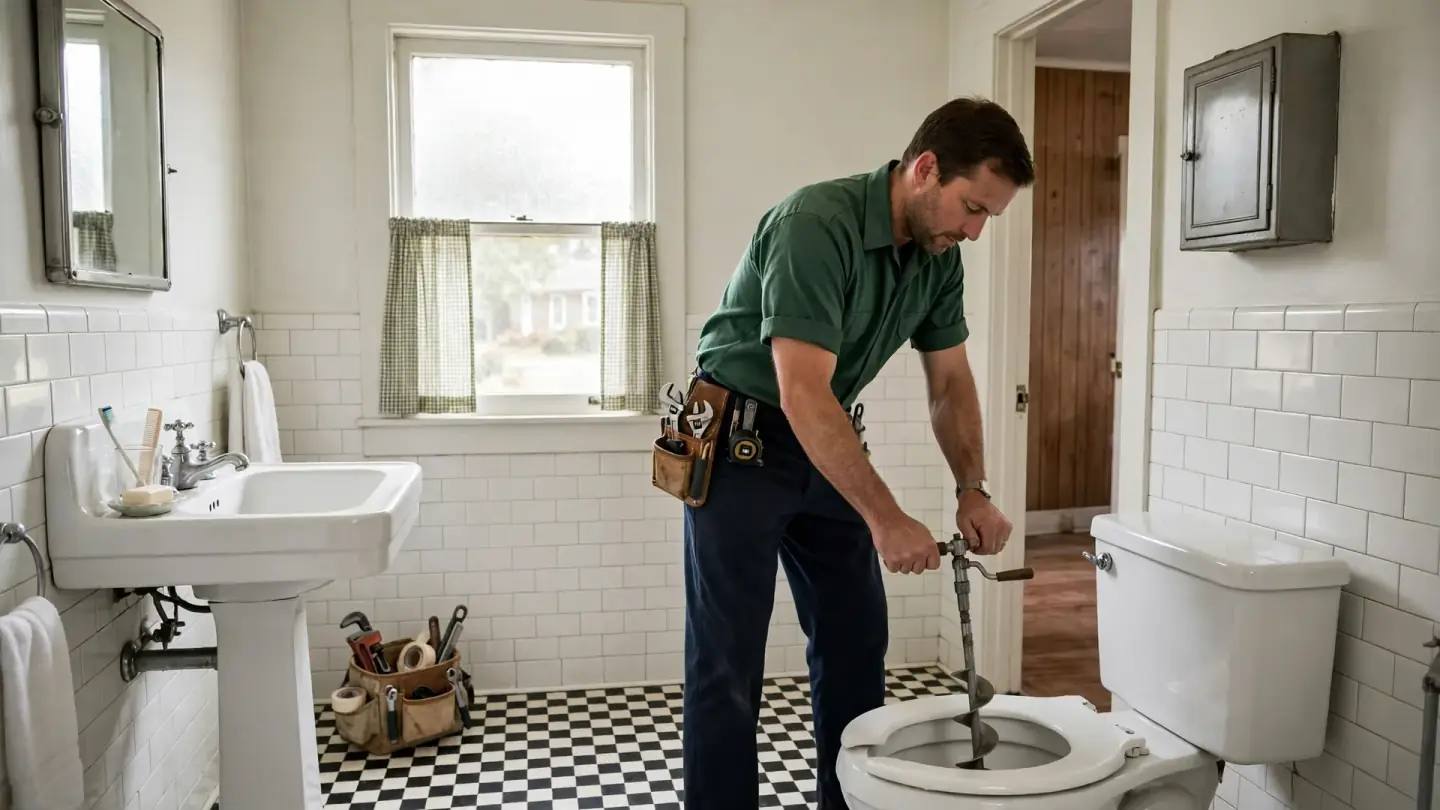
A short auger with a protective sleeve feeds through the porcelain without scratching it and pulls back paper, wipes or soft objects.
- 3
Pull the toilet if needed
For a hard object or a plug in the closet bend, the toilet is lifted off the flange so the blockage can be reached directly.
- 4
Cable beyond the bend
With the toilet off, a larger cable can run down the branch toward the stack if the blockage is further along.
- 5
Reseat with a fresh seal
The toilet goes back on a new wax ring or foam seal and is test-flushed several times while the base is watched for leaks.
Phone or wait
Which toilet blockages need a contractor tonight?
Call when the toilet is the only one in the home, when someone in the house cannot manage without it, when something solid went down, or when the bowl rises on its own without a flush. Those situations rarely improve by waiting and can quickly turn into water on the floor.
If there is a second working toilet and the blocked one is contained with its valve closed, many households choose to wait. In that case, routine toilet drain clearing is the right service. If the toilet clears but the problem keeps returning every few weeks, a drain camera inspection can show whether the cause is a sag, roots or a partly blocked main.
On the call, say whether anything solid went down, how many toilets the building has, and whether other drains are acting up. That helps the contractor you're connected with decide what to bring and whether the toilet may need to come off the floor. When the tub fills as the toilet drains, the bathroom emergency page is a better fit, and the services list covers everything else.
FAQ
Overflowing toilet questions
How do I stop my toilet from overflowing right now?
Reach behind the toilet and turn the supply valve clockwise until it stops. If the valve is stuck, lift the tank lid and raise the float so the fill valve shuts off. Do not flush again. Bail some water from the bowl into a bucket so you can plunge without spilling it over the rim.
Why does my toilet clog every time I flush?
Repeated clogs often come from something stuck in the trapway, such as a toy, wipe or hygiene product, that catches paper each time. They can also mean a blockage further down the branch or main line. A contractor can use a closet auger or remove the toilet to find out which it is.
Is it bad to flush wipes labelled flushable?
Yes, it can be. Many wipes sold as flushable do not break down quickly like toilet paper and can catch in trapways, laterals and sewer pumps. Utilities widely advise flushing only toilet paper and human waste. Put wipes in the trash, even when the packet says they can be flushed.
What does it mean when my toilet gurgles and the tub drain bubbles?
Gurgling at the toilet while the tub bubbles usually means air is being pushed through a blocked or partly blocked shared branch or vent. It is an early warning that the line is closing. Avoid heavy use and call to have the branch checked before it backs up completely.
Should I use a chemical drain cleaner in a clogged toilet?
No. Most chemical cleaners are not designed for toilets, can damage the wax seal or old pipes and may splash when you plunge afterwards. A flange plunger or a closet auger is safer. If those fail, a contractor has tools that reach further without harming the porcelain.
When is a clogged toilet an emergency and not a next-day job?
It is urgent if it is your only toilet, if water is spreading across the floor or through the ceiling, or if other drains are backing up too. A single clog in a home with another working toilet can usually wait for a normal booking with a local contractor.