Key facts: Hydro Jetting
- Grease poured down drains solidifies and blocks sewers; Dayton asks residents to put grease in the trash [1].
- The U.S. Geological Survey classes Miami Valley groundwater as very hard, which is why mineral scale shows up in older drain lines here [2].
- Dayton's water plants use conventional lime softening before distribution [3].
- The City sets no fixed root-cleaning schedule for laterals; it depends on pipe condition and nearby trees [1].
How it works
What the jetter nozzle does to grease in a 4-inch line
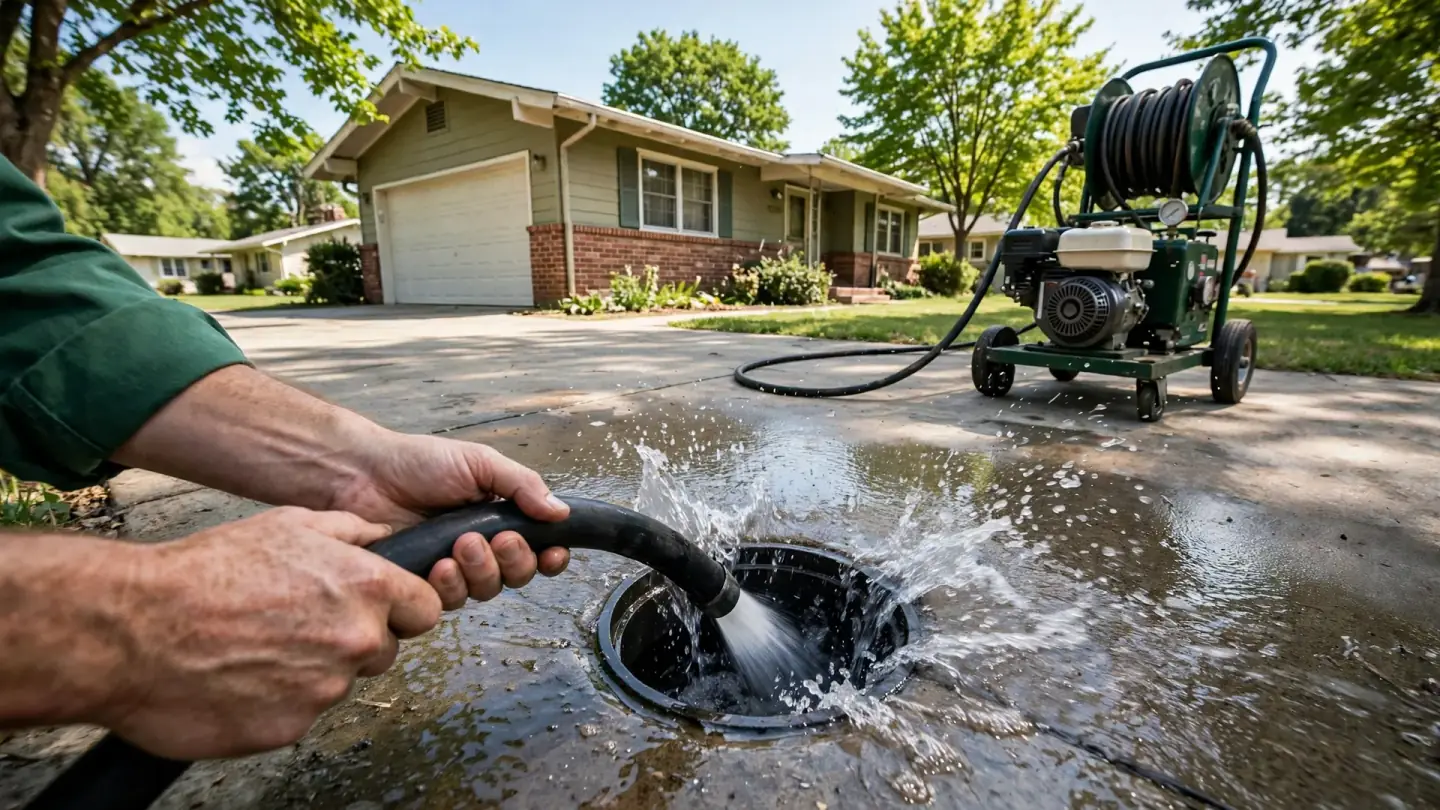
A drain jetter is a pump, a reinforced hose on a reel and a nozzle. The nozzle is what does the work. Most have one forward jet to cut into a blockage and several angled rear jets. The rear jets do two things at once: they pull the hose forward up the pipe, and they spray back against the wall in a full circle, peeling off whatever is stuck there.
In a 4-inch house lateral packed with kitchen grease, a cable cutter tends to bore a neat tunnel through the middle and leave a thick ring on the wall. Water flows again for a while, then food scraps catch on that ring and the line closes up. A jetter goes past the plug, and as the hose is drawn back slowly the rear jets strip the ring off and send it downstream toward the main as loose fragments.
Different nozzles suit different jobs. A penetrating nozzle with a strong forward jet opens a solid plug. A flushing nozzle with mostly rear jets cleans the wall. A rotating nozzle spins its jets to scrub scale. A root-cutting head uses the water to spin a cutter for fine root hair at clay joints. Hose size and pump output are matched to the pipe, so a small kitchen branch gets a much gentler setup than a commercial main.
Jetting is not always the first tool. On a single slow sink, the right first move is usually simpler, covered under kitchen drain cleaning. Jetting earns its place when a line keeps returning, when grease or scale has narrowed the whole run, or when a pipe needs to be fully clean before a camera survey or a lining repair.
Signs
Does my line need washing rather than snaking?
Snaked twice, clogged again within months
Quick returns after cabling usually mean the wall is coated and the cable only opened a channel. Jetting removes the coating instead of tunnelling through it.
Grey, waxy chunks come up the cleanout
Hardened fats in the trap or at the cleanout tell you what is lining the rest of the pipe. That material is what a flushing nozzle is built to remove.
Slow everywhere, not blocked anywhere
When every fixture on a line drains sluggishly but none stops, the pipe bore is shrinking. Scale and soap build-up behave this way, especially on hard well water.
Root hair at joints on the last camera run
Fine roots at clay joints are often better washed out than torn. A root-cutting head on a jetter can clear them while the camera checks the joint underneath.
A restaurant or shared kitchen line
Commercial grease loads build up fast. Scheduled jetting keeps the line open between grease trap services rather than waiting for a backup at the busiest hour.
A lining repair is planned
A liner needs a clean host pipe to bond and seal. Jetting before lining is a standard preparation step, followed by a camera check.
The jetting job
Order of work on a Dayton jetting visit
- 1
Camera the line before any pressure
The contractor runs a camera to confirm what is in the pipe and that the pipe is sound. A crack, belly or collapse changes the plan before water goes in.
- 2
Choose the access and the nozzle
An outdoor cleanout is the usual entry for a lateral; a kitchen line may be jetted from a cleanout or a removed trap arm. Nozzle and pressure are picked for the pipe size and material.
- 3
Open the blockage first
If there is a solid plug, a penetrating nozzle cuts through so water can flow and carry debris away. A flooded line is relieved before deeper cleaning.
- 4
Clean the wall on slow retraction
The hose is fed to the far end, then pulled back slowly so the rear jets scour the full circumference. Heavy grease runs may take several passes.
- 5
Flush and watch the outflow
Running water through the line carries the loosened material down to the main. What comes out tells the contractor what was coating the pipe.
- 6
Camera again and show you
A second camera run proves the wall is clean and checks joints that were hidden under grease or roots. You see the before and after on screen.
Methods compared
Jetting, cabling and enzyme treatment side by side for Dayton lines
| Method | Best at | Weak spot | Where it fits |
|---|---|---|---|
| Hydro jetting | Grease, scale, sludge, fine roots on the wall | Not for broken or collapsed pipe | Recurring clogs, mains, pre-lining |
| Cable machine with cutter | Solid plugs, heavier roots, foreign objects | Leaves a coating on the pipe wall | First response to a full stoppage |
| Hand auger | Traps and short fixture branches | Short reach, little cleaning action | Single sink, tub or toilet |
| Enzyme or bacterial product | Slowing new grease film between cleanings | Will not open a blocked line | Upkeep after a line is clean |
| Caustic chemical opener | Small soft clogs near the fixture | Harsh on old pipe and on whoever opens it next | Better avoided before a contractor visit |
DIY vs where to stop
What a homeowner can do about grease and scale before calling
- Wipe pans and pour cooled grease into a can for the trash. Dayton's sewer FAQ asks residents to keep grease out of drains because it solidifies and blocks sewers [1].
- Run hot water after the dishwasher drains, not instead of keeping grease out. Hot water moves grease further down the line before it sets again.
- Clean the stopper and the first few inches of a bathroom drain by hand. Hair and soap at the top are a homeowner job.
- Do not rent a jetter for a house lateral. Pressure that will cut grease will also cut skin, and a jet pointed at a cracked clay joint can make it worse.
- Do not stack chemicals. A caustic opener followed by an acid one, or either followed by a jetter, can splash back hard.
- Stop when water rises in the basement floor drain. That means the lateral is involved and it is time for a contractor with a camera.
Dayton specifics
Hard aquifer water, lime softening and what coats Dayton pipes
The Dayton area sits over the Great Miami River Buried Valley Aquifer, and the USGS describes the surface and ground water across the Great and Little Miami basins as very hard calcium-magnesium-bicarbonate water [2]. Homes on private wells or unsoftened supplies draw that water straight into their plumbing, and over years the minerals combine with soap to form a crusty layer inside drain lines.
City of Dayton customers get water from the Ottawa and Miami plants, which use conventional lime softening, then pH adjustment, fluoridation, chlorine and rapid sand filtration [3]. Softening reduces scale, but it does not stop soap scum and grease from building up; it simply changes how fast it happens. A rotating jetter nozzle is the usual tool for scrubbing that layer off without cutting the pipe.
Grease is the other half. The City's FAQ is blunt that grease poured down a drain solidifies and blocks the mains, and that restaurants should install and maintain grease traps [1]. When a Dayton kitchen line is jetted, the loosened grease goes to the public main, so the goal is a clean line and a household habit change, not a cycle of jetting the same grease every few months.
Old clay laterals under neighbourhoods like the Oregon District and South Park need care. Jetting pressure is turned down on clay, and the contractor checks joints on camera first. If the footage shows a crack or an offset joint, the plan shifts toward a sewer line inspection and repair rather than more water.
Ownership matters for planning. Upkeep of the house's own sewer connection, out to where it joins the street sewer, falls to the owner, and the City has no set root-cleaning schedule for private laterals [1]. How often to jet is a judgement made from your own footage, not a City calendar.
When cleaning isn't enough
When will hydro jetting not fix the pipe?
Jetting cleans pipe that is still a pipe. If the post-jetting camera run shows a clean wall but a joint dropped out of line, the line will keep catching paper there however clean it is. If a section has a belly holding water, grease will settle in that low spot again. And if soil or stone appears in the bore, the pipe has broken and needs repair.
In those cases the jetting still has value: it gives the camera a clear view and it is the cleaning step a lining contractor needs. But the honest answer becomes a repair. On the private side that means a licensed plumber and a permit, and any digging starts with an Ohio811 call two working days ahead [1].
If the line is sound and clean, the next question is how to keep it that way. A preventative drain maintenance schedule based on what the camera found is usually the better long-term plan than waiting for the next stoppage.
If jetting is not the right fit, see the other options in our list of Dayton drain services.
FAQ
Hydro jetting questions for Dayton homes and kitchens
Is hydro jetting safe for an old clay sewer lateral?
Hydro jetting can be safe on clay pipe if the line is intact. The contractor should run a camera first, choose a lower pressure and suitable nozzle, and stop if the footage shows cracks, missing pieces or offset joints. Water under pressure can make that kind of damage worse. Many Dayton laterals are older clay, so the camera step matters.
Why does my kitchen line clog again a few months after snaking but not after hydro jetting?
Snaking bores a hole through grease and leaves a coating on the pipe wall, while jetting strips that coating off. Food scraps and fresh grease catch on the leftover film, so the clog rebuilds quickly. Jetting returns the bore to close to full size. That is why lines that reclog after every cable run are the usual candidates for a jetter.
Does Dayton's softened city water mean hydro jetting is never needed for scale?
No; softening reduces scale, but soap scum and grease still build up in drain lines. Dayton's plants use conventional lime softening before distribution [3], which helps. Homes on private wells drawing very hard aquifer water [2] usually see more mineral buildup. Either way, jetting is mostly about grease and soap film in kitchens and older branch lines.
Can hydro jetting remove tree roots from a sewer line?
Jetting removes fine root hair at joints, especially with a root-cutting nozzle. Heavy root masses often need a mechanical cutter first. Either way, roots grow back through an open joint, so recorded camera footage matters for planning. The City sets no fixed root-cleaning schedule for laterals; it depends on pipe condition and nearby trees [1].
Where does the grease go after a line is hydro jetted?
It is carried downstream to the public main as loose fragments in the flushing water. That is one reason Dayton asks residents to put grease in the trash rather than the sink [1]. Grease that hardens in the main can cause backups for the whole street. Better habits at home also stretch the time between jetting visits.
Will hydro jetting fix a basement drain that backs up after rain?
Only if the cause is buildup in your line. Rain-related backups often come from an overtaxed City main or from downspouts and foundation drains tied into the sanitary line [1]. Jetting a clean pipe will not help either case. A camera run first shows whether there is grease or roots to remove, or whether the water source is elsewhere.
Should I see camera footage before and after hydro jetting?
Yes, a camera run after jetting confirms the pipe wall is clean and reveals joints the grease or roots were hiding. Footage before the job shows why jetting was chosen. Ask for both recordings so you have a baseline for the next visit and evidence if a defect needs repair later. It takes little extra time on site.