Key facts: Toilet and tub backing up together
- The pipe carrying waste from the building to the public sewer belongs to the property, so its care falls on the owner in Dayton [1].
- Dayton's sewer maintenance division cleans and repairs the public main, not the private lateral [1].
- Grease poured down drains solidifies and blocks pipes; the City asks residents to bin it [1].
- Traps hold a water seal; vents let air in so traps are not siphoned [2][3].
Short answer
Why does flushing the toilet fill my bathtub?
A toilet and tub on the same floor usually drain into one branch that runs to the main stack or building drain. The tub drain sits lower than the toilet rim, so when the shared pipe is blocked below where they join, the flush has to go somewhere, and it rises out of the tub. Grey water, sometimes with toilet paper, in the tub after a flush means the restriction is past the junction.
If basement drains, a floor drain or a lower-floor shower also fill, the blockage is in the building drain or lateral, which the owner is responsible for in Dayton [1]. If only that bathroom is affected, the branch is the likely spot.
Access at the cleanout
Safe checks
What to do while water is in the tub
- Stop flushing toilets and running water everywhere in the house until you know how far the blockage reaches.
- Check the lowest drains: a basement floor drain or lower shower with water in it means the main line.
- Do not plunge the toilet hard while the tub is full; you may push water and waste up into the tub.
- Skip chemical openers. The water in the tub is contaminated and chemicals make it more hazardous.
- Wear gloves if you need to bail or clean, and keep children and pets out of the bathroom.
- Find your cleanout so the contractor can reach the line quickly; do not open it while water is backed up.
Cause 1
Blockage in the bathroom branch
The branch below a bathroom collects everything from the toilet, tub, shower and sometimes the basin. Wipes, heavy paper use, hair from the tub and soap scum combine in the pipe where it changes direction. Once the bore is narrow enough, a flush cannot get past, and the tub becomes the overflow.
Clearing this kind of blockage is usually done through the toilet, after pulling it, or through a branch cleanout. Toilet drain clearing and shower and bathtub drain cleaning both start here.
Cause 2
Is it the main sewer line if the toilet and tub back up together?
When more than one bathroom or the basement shows water, the blockage is in the shared building drain or the lateral to the street. Roots in older clay joints, grease from kitchen use and collapsed or offset sections are common. The City's Division of Sewer Maintenance handles the public main, but the lateral belongs to the owner [1].
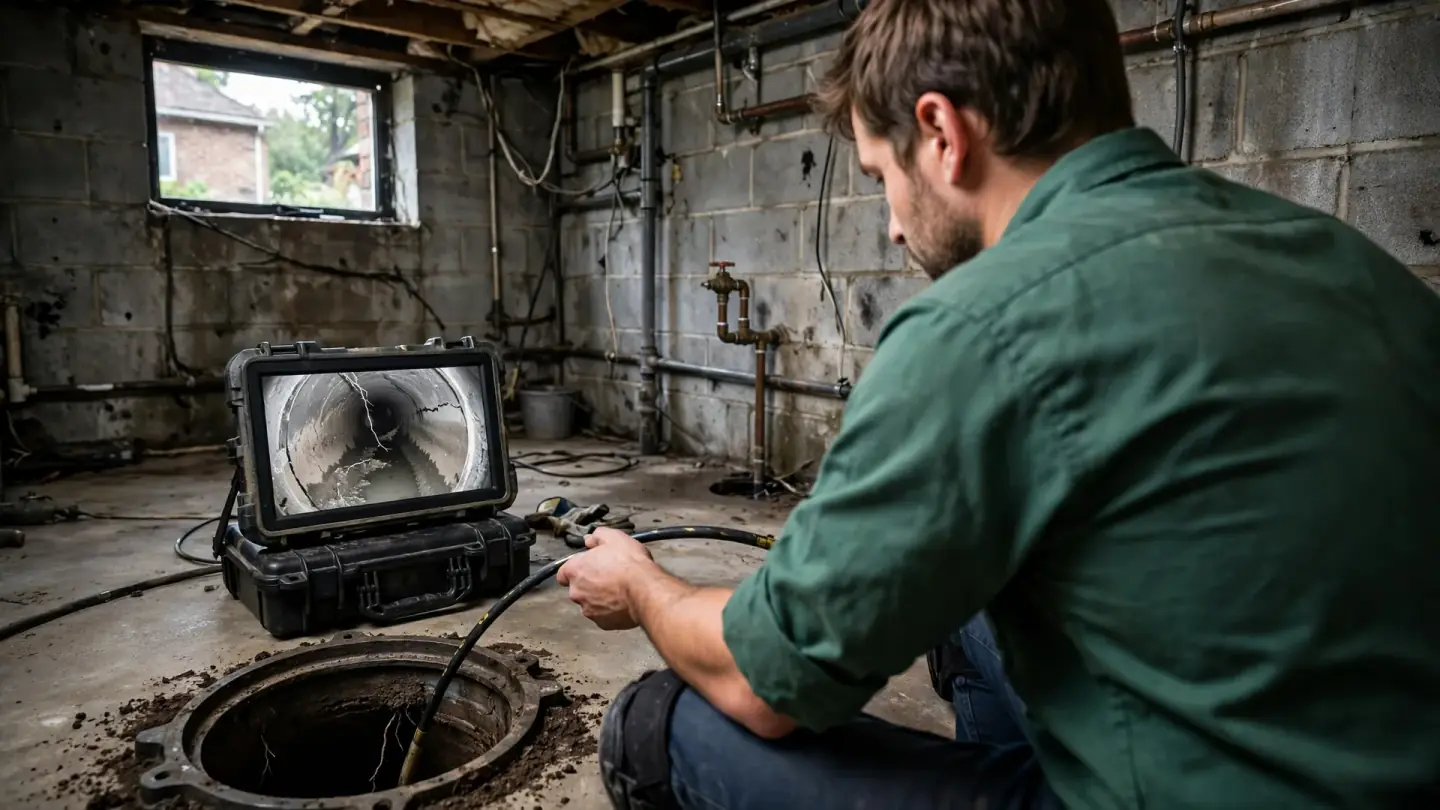
These are cleared from the main cleanout with a larger cable machine or a jetter. A follow-up sewer line inspection on camera shows whether the line has a defect that will block again.
Cause 3
When the vent makes it worse
Traps hold a water seal against sewer gas, and the vent system lets air in so those seals are not pulled out [2][3]. A blocked vent does not usually cause a full backup on its own, but it slows drainage and makes toilets and tubs gurgle and bubble against each other. If the line is clear and the gurgling continues, read our gurgling drains guide.
Prevention
Keeping toilet and tub flows apart
- Flush only toilet paper; wipes labelled flushable still build up in branches.
- Use a hair catcher in the tub and clean it after use.
- Keep grease out of kitchen drains, which share the building drain [1].
- Schedule main line cleaning if roots were found on camera.
- Act on early gurgling before it turns into a full backup.
What to tell the contractor
What to describe when the tub fills on a flush
- Which bathroom, and whether other bathrooms or the basement are affected.
- Whether the water in the tub has paper or waste in it.
- Whether you have a basement cleanout and where it is.
- How long it has been building, such as gurgling or slow tub drainage beforehand.
- Any history of root clearing or camera work on the line.
FAQ
Toilet and tub backup questions
Why does the tub fill up instead of the toilet overflowing?
The tub drain sits lower than the toilet rim, so water backing up from a blocked shared line rises there first. That tells you the blockage is downstream of the point where both fixtures join [3]. The further down the blockage, the more fixtures will be affected, including basement floor drains.
Should I plunge the toilet when water comes up in the tub?
Plunging often just pushes the water into the tub rather than clearing the line. If the tub is already filling, the blockage is usually beyond the toilet's own trap and out of a plunger's reach. Stop flushing, and call to describe what happens so a contractor can clear the shared line properly.
Who is responsible when the blockage is under my yard in Dayton?
The private lateral between the house and the public sewer is the owner's to maintain. The City of Dayton maintains the main itself [1]. If neighbours are backing up too, the main may be involved, and the City's Sewer Maintenance division is the place to report that.
Is the dirty water in the bathtub safe to clean up myself?
Treat it as contaminated sewage. Wear gloves, keep children and pets away, and avoid splashing. Once the line is cleared and the water drains, clean the tub and any splashed surfaces with disinfectant. Wash hands thoroughly and launder any towels used during the cleanup.
Will the toilet and tub back up again after the line is cleared?
It depends on what caused it. Wipes or a single blockage may not return, but roots, a sag or a broken pipe usually will. A camera inspection after clearing shows which you have, so you can decide whether a follow-up repair or routine cleaning makes sense.
Can I keep using the sink while the tub has backed-up water in it?
Avoid it, because the sink very likely feeds the same blocked line and will add to the water in the tub. Hold off on all fixtures in the house if possible, including the washer and dishwasher, until the line is cleared. Every gallon sent down has to go somewhere.
Where does a contractor clear a shared toilet and tub backup from?
Usually from a cleanout, an access fitting on the building drain, or by pulling the toilet to reach the line [2]. Working from a cleanout avoids pushing debris back through bathroom fixtures. Afterwards, running a camera through the same opening shows what was causing the blockage.