
Key facts: Roots in clay laterals
- Dayton property owners are responsible for the house lateral from the building to the main [1].
- The City says there is no set schedule for root cleaning; it depends on the lateral and nearby trees and shrubs [1].
- Vitrified clay pipe has a long service life and resists sewage chemistry but has more joints per run than plastic and is brittle [2].
- Tree roots are a recognised cause of sewer blockages and overflows alongside grease and debris [3].
Short answer
How do tree roots get into a clay sewer pipe?
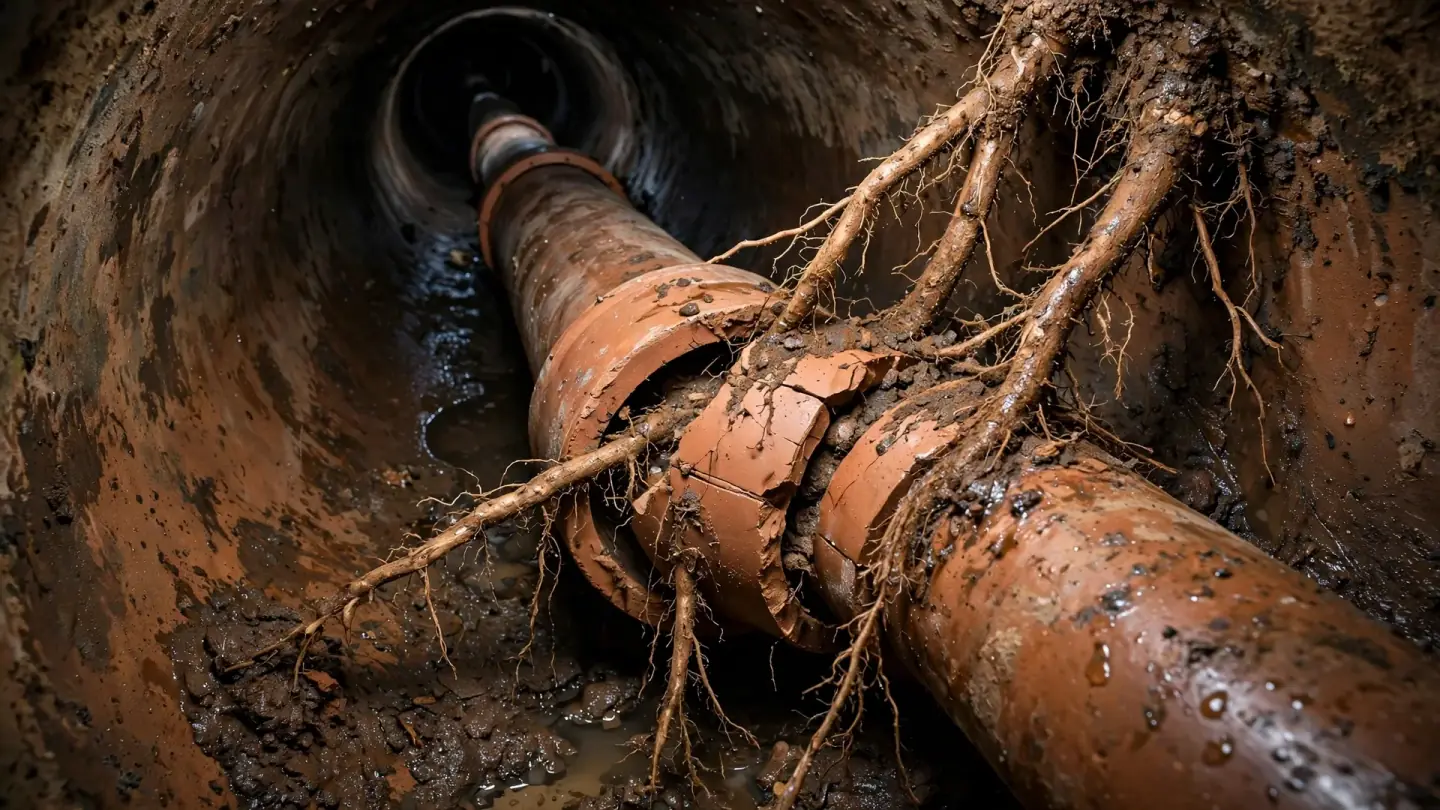
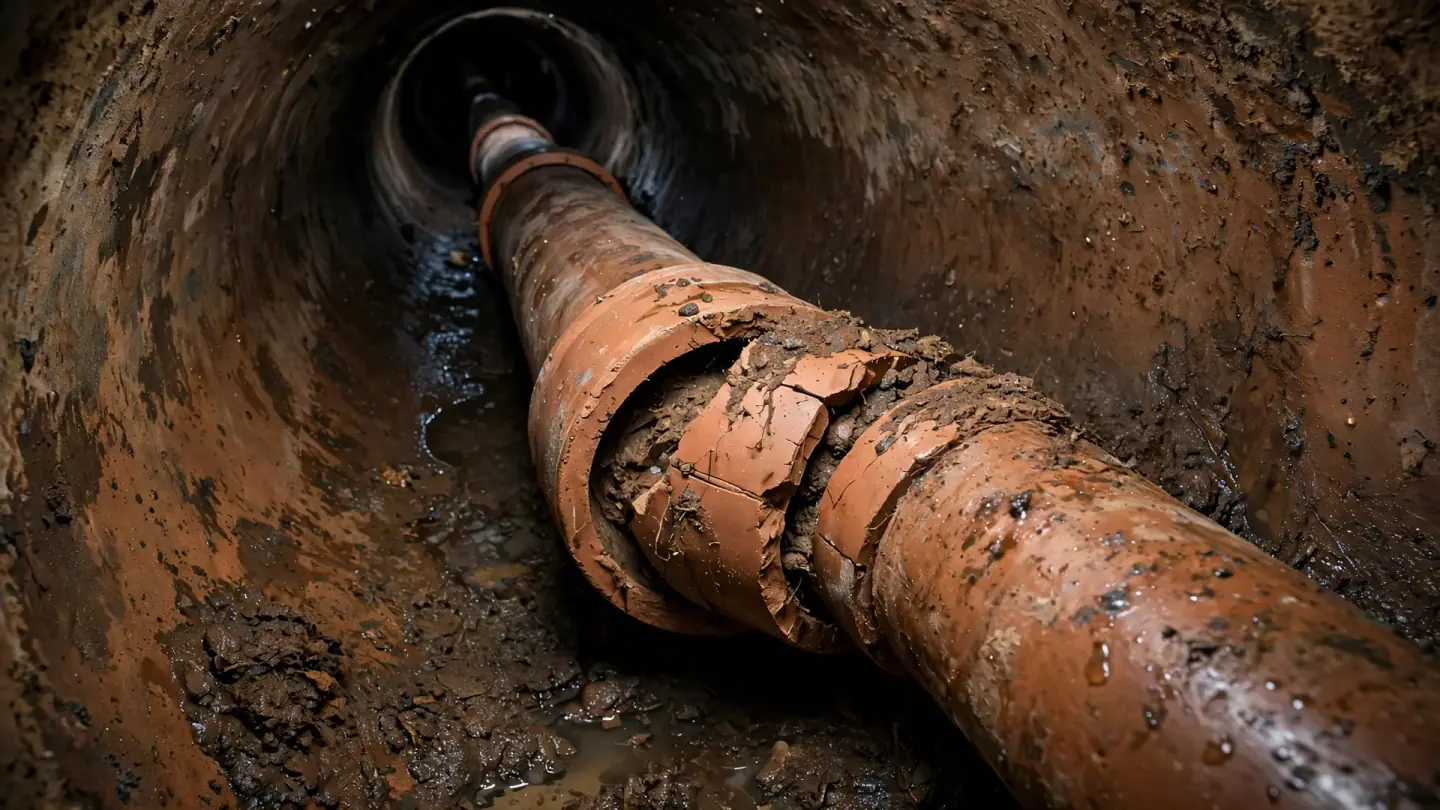
Clay sewer pipe is laid in short sections joined end to end. The pipe itself is hard, fired ceramic that stands up well to sewage [2], but the joints are its weak spot. Over decades, mortar or early gaskets crack, the ground shifts, and a little warm, nutrient-rich moisture escapes. Fine roots follow that moisture, slip through the gap, and once inside the pipe they branch into a dense mat.
The mat catches toilet paper and grease, the flow slows, and eventually the lateral backs up. Roots are one of the recognised causes of sewer blockages, alongside grease and debris [3]. In Dayton, keeping the lateral clear is the owner's job [1].
What you see / likely cause / what to do
Root intrusion symptoms and what they mean
| What you see | Likely cause | What to do |
|---|---|---|
| Toilets slow, worse after laundry | Root mat narrowing the lateral | Book main sewer line cleaning |
| Backup returns about a year after clearing | Roots regrowing at the same joints | Set a cleaning interval before that point |
| Gurgling in the lowest drains | Partial blockage trapping air | Have the lateral cleared and filmed |
| Lush strip of lawn over the line | Leaking joints feeding roots | Camera inspection to check for cracks |
| Pieces of root in the cleanout | Active root intrusion | Cut, flush and film; discuss repair |
Roots after cutting
Safe checks
Checks you can make for root trouble
- Note which drains slow first. The lowest fixtures usually show a lateral problem first.
- Look at the lawn along the likely path of the lateral for a strip that stays greener in dry weather.
- Find your cleanout and see whether it has a removable cap; do not open it if drains are backing up.
- Write down when backups happen; roots often follow a seasonal pattern.
- Look for large trees between the house and the street, including the tree lawn.
Deep dive
Why are clay laterals so common in older Dayton neighbourhoods?
Clay was the standard sewer material for generations. South Park, with more than seven hundred structures mostly from the late nineteenth and early twentieth century [4], and the Oregon District were built when clay and cast iron were the norm. Many Belmont homes from the interwar and postwar years have clay laterals too. Mature street trees in these areas make the combination especially root-prone.
Clay's strengths are real: it resists most sewage chemistry and tolerates aggressive cleaning better than plastic [2]. Its weaknesses are the number of joints and brittleness, which can lead to cracking and leakage [2].
Deep dive
Cable cutting versus water jetting for roots
A sectional or drum cable with a root-cutting head is the classic tool. It shears roots at the pipe wall and restores flow quickly. Hydro jetting with a root-cutting nozzle can clean the wall more completely and flush the debris away, which can lengthen the time before regrowth. The choice depends on how dense the roots are and how sound the clay is; cracked pipe calls for care with either tool.
Neither method removes the root outside the pipe. That is why the City notes that root cleaning has no set schedule and depends on the lateral and the trees around it [1].
Deep dive
Who handles roots under the sidewalk and street?
The owner's responsibility runs all the way to the main [1]. On the private side, a licensed plumber with a permit does repairs. When a broken section is under the street side, the plumber pulls a permit and contacts Sewer Maintenance, and City crews handle that work, billing the plumber, who bills the owner [1]. The City will not locate your lateral, but a plumber can find it with a probe [1].
How a contractor diagnoses it
How a contractor confirms root intrusion
- 1
Open from the cleanout
The contractor works from the basement or outdoor cleanout, or pulls a toilet if there is none.
- 2
Cut through the mat
A cutter head opens the line; root fibres coming back on the cable confirm the cause.
- 3
Flush the line
Water clears loosened roots and paper so the camera can see the joints.
- 4
Film every joint
A sewer line inspection records each entry point, cracks and offsets, with distances from the cleanout.
- 5
Talk through the options
Sound pipe with light roots gets a cleaning interval; cracked or heavily invaded pipe gets a repair discussion.
Fix options
Repeat cleaning, lining or replacement
If roots enter at a handful of joints and the clay is otherwise sound, scheduled cleaning is often the sensible answer. If roots return within months, if the pipe is cracked, or if joints have shifted, repair options such as spot repair, lining or replacement come into play, with a permit for the private side [1]. Ask to see the footage and the distances before any repair is agreed. The guide on how often to clean drains covers setting an interval.
Prevention
Slowing root regrowth in a clay lateral
- Schedule cleaning ahead of the backup interval your house has shown.
- Ask for jetting after cutting where the pipe is sound, to clear the wall more completely.
- Plant new trees well away from the path of the lateral.
- Keep wipes and grease out, since they bind to roots and close the line faster.
- Use preventative drain maintenance to keep a record of each cleaning.
What to tell the contractor
What to mention when roots are suspected
- Previous backup dates and whether roots came out last time.
- Where the cleanout is and whether it is inside or outside.
- Large trees near the house, in the tree lawn or across the street.
- Any old footage or reports on the lateral.
- Whether neighbours on the street have had root problems.
FAQ
Root and clay lateral questions in Dayton
How do I know if tree roots are in my sewer line?
The best proof is a camera inspection after clearing. Common clues are drains that slow over months, backups that recur around the same time each year, gurgling in the lowest fixtures, and root fragments on the cable after a previous cleaning.
Will the City of Dayton remove roots from my sewer lateral?
No, the lateral is the owner's responsibility from the house to the main [1]. A private contractor clears roots on the lateral. The City maintains the public main and handles street-side repairs, billing them through the plumber [1].
Do roots grow back after a sewer line is cleaned?
Yes, usually. Cutting removes the roots inside the pipe but not the root system outside, so they return through the same joints. How fast depends on the tree, the season and the gap. Footage after each cleaning shows the pace.
Is hydro jetting safe for an old clay sewer pipe?
On sound clay, generally yes; vitrified clay tolerates aggressive cleaning better than plastic [2]. Clay is brittle, though, so cracked or broken sections need care. A camera look before or after jetting shows whether the pipe can take it.
Should I cut down the tree that's near my sewer line?
Not as a first step. Roots can be managed with regular cleaning, and removing a mature tree is a big decision. If the camera shows serious pipe damage from roots, repairing that section is usually the more direct fix.
Do I need a permit to replace a clay sewer lateral in Dayton?
Yes. The City says a licensed plumber pulls a permit for lateral repairs; private-side work is done by the plumber, and street-side work is coordinated with Sewer Maintenance [1]. Separate cities near Dayton have their own permit offices.